
Tag: EliteFTS
The Practice of Overcoming Fear
Originally posted on EliteFTS

Fear is a powerful human response, as it should be. It is our primal risk management tool that controls actions and even the nervous and hormone systems to keep us safe. Although fear is a risk management tool that keeps us safe, it can also hold us back from challenges, opportunities, and the success had from overcoming those.
You can only realize your full potential when you take risk and push yourself to your limits. There are differences in risk tolerance and ability to overcome fear between people. This difference, and one’s individual tolerance level for risk, is one of the defining things that have separated the great leaders and visionaries in history from…well, the rest of us. It is also, however, what separates those that could have been remarkable historical figures, but instead died young, lost their fortunes, or destroyed themselves in some other fashion.
Heightened reward simply comes with heightened risk and potential for failure. But if you seek to live an epic life worth writing about, the question you need to ask is, “How do I effectively improve my ability to overcome fear and improve my ability to tolerate risk?”
This means not trying to negate all response to risk, but trying to turn it into a logical decision-making process and not a primal response. Understand that fear is a primal risk-management tool that employs only your body and mind’s perception of risk without utilizing the logical thinking and analysis tools we have developed over time. As you improve your ability to overcome fear and tolerate risk, you will have to rely on these tools to take an objective look at the risk you are putting on yourself. If you are going to short circuit or dampen your natural response to risk, it does need to be replaced with something else. This way you can decide how you want to balance comfort and stability against a storybook life, but one with the potential for also ending up dead, broke, or derelict.
An example would be not having any level of fear and being challenged to a game of Russian roulette. Without fear, you may actually engage in this game. However, if you employ a little thought, you will realize that you have one in six chance of death.
Here are some methods for improving risk tolerance, organized with the easiest to employ but least effective and ending with hardest to employ but most effective:
- Logical Thought
- Specific Exposure
- Random Planned Exposure
Logical Thought
Logical thought is much like the Russian roulette example above but done in reverse. It is simply using the advanced logical thought and analysis tools to overcome the fear. It does work, proven by people jumping out of airplanes with parachutes on. Sure, there is still some level of fear but not enough to keep someone from jumping as they know that the aerodynamics of the parachute will keep them alive. We are reduced to having fear about the chute actually opening or something else going wrong. While it does work, it only works for the very specific examples and usually doesn’t stop fear as a whole around other activity.
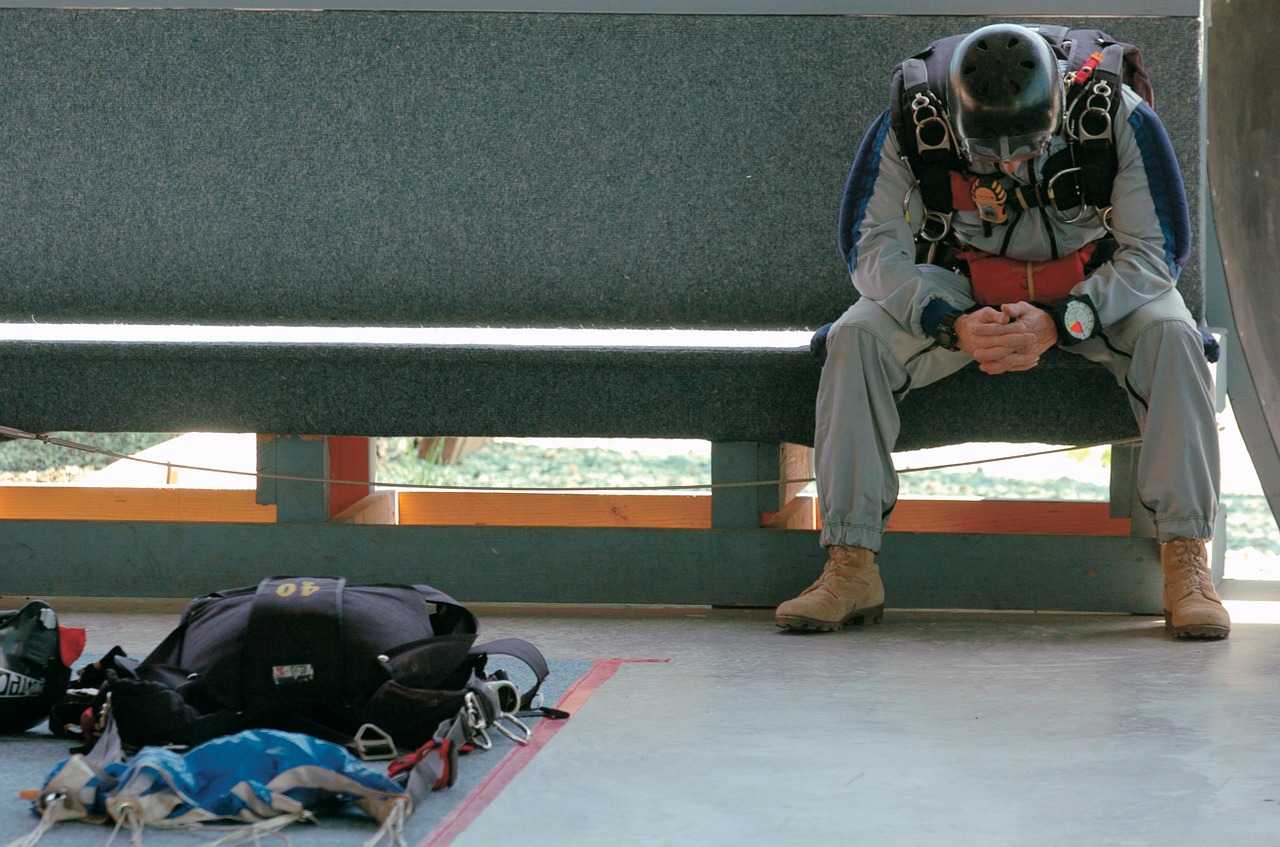
Fear is still in place and just working on a number of other levels, reducing one’s performance and ability to realize potential. Fear creates a negative spiral of thought once initiated, which consumes your mental capacity, slowing and clouding your mental and physical reactions and your decision making. This is the “what if” fear spiral. A “what if” is fear about something else going wrong.
Sure, you’re not afraid that the concepts that keep a parachute afloat will suddenly fail to work, but other fears such as getting separated from instructor, the parachute not being packed right, freezing and not pulling cord, or others come into play. Once the “what if” happens, things begin to spiral. What if I don’t complete this project on schedule, then I lose my job, then I can’t make my house payment? This is how your mind gets consumed. You’re thinking down these paths and not focused on acting to your maximal potential in the present — not realizing your potential.
Specific Exposure
Specific exposure is the next step in overcoming fear. To do this, simply expose yourself to fear repeatedly. This is very effective. Generally, overcoming a specific fear is much harder than the actual activity that you are scared of. You may be scared of speaking in public, but after doing so, you realize it was much easier than the actual stress you put yourself under leading up the that event. A favorite example of mine is that simply overcoming the fear of squatting 1000 pounds is a harder task than actually developing the ability to do so. So many things can go wrong that if you walk up to that bar without a complete lack of fear that the “what if” spiral it creates will destroy any possibility you achieving that lift.
You cannot doubt yourself if you want accomplish this task. A mind clear and focused on the task at hand and reacting at optimal speed with confidence is the only way you can pull off that lift.
RECENT Mastery of Skill: Humility and Confidence
Doubt and “what if” spirals are how fear holds you back. Specific exposure to this environment will allow you to overcome this fear, but is harder to achieve in actuality than developing the strength to do so.
Random Planned Exposure
Random planned exposure, while an oxymoron in title, is an accurate description, as you never know where the opportunities for taking risk will be in the future. You must plan on taking them, though. This is where overcoming fear becomes a practice and a part of your life.
Just like you never know where that big opportunities or overwhelming challenging will be in the future, or what it will be, you must be prepared to act when the time comes. This means you have not had the chance to apply specific exposure techniques, you must be prepared for handling fear of the unknown. To prepare you need to make a practice of finding the things that make you uncomfortable in life and jumping into them. Constantly push yourself into unknown territory as a practice. This is not something that comes naturally, as human nature is to fall into routine. Life moves on and moments of chaos and decision arise, and when this happens don’t take the easy path that allows you to not make a change and fall back into routine.
You must stay in the practice of conquering and living in the unknown. When it comes to a new job, are you going to take that job that is going to challenge you or are you going to stay with the one you can do with your eyes closed? As a shy introvert, my choice for a career in leadership and human interaction was the best thing I could have done. If you’re afraid of commitment, are you going to run away when you find someone that you think may actually be the one for you?
Never stop living life. Step outside the routines, the tasks, and choose the path of walking directly into the unknown. The unknown is the scariest place of all to step but it is the path to growth and personal achievement. Where are you right now in life and what are you doing? Are you growing? Are you finding a path through some unknown territory? If not, you need to find it or you’re just letting life live you.
Powerlifting Legend Ed Coan and Chris Duffin Talk Shop
This weekend I had the opportunity to spend a couple full days working with Ed Coan. We had a great deal of success in working through some issues he has and establishing a path forward. During the time we also had a lot of back and forth knowledge sharing.
It was a tremendous honor for me to host Ed for the weekend at EPC in Portland and to have his trust for seeking me out. At the end of the period we filmed an incredible interview covering a number of great topics that I think are worth the watch. Make sure to check out the ShouldeRök™ Ed mentioned and subscribe to our newsletter for weekly insights.
The Role Of A Team In Individual Sports
People often under value the role of a team in individual sports. That statement is not an oxymoron as team and individual performance are not diametrically opposed. While it is true that lifting can, and is, done by some individuals entirely by themselves there are substantially more strength athletes who gain from relying on their team.
The role of a team in an individual sports such as powerlifting, olympic lifting and even to some degree bodybuilding is:
- Encouragement – That encouragement or support to dig deeper and push harder
- Reality Checks - Calling out your depth isn’t good or that you didn’t lock that out. Or you just being flat out stupid with your training
- Remove Obstacles – Assisting lifters at meets, reminders to stay hydrated or just keeping the focus on a big training day.
- Physical Support – Spotting, loading, lifting off, or helping with gear
We are social beings and we simply perform better in supportive groups than when we do alone. I am a big proponent of training in teams. Even without a team physically present we can see people using social media to seek out and fill those same team roles noted above.
It’s not just powerlifting or strength training that operates this way. Many ‘individual sports’ you see today require teams to succeed. Look closely and you will see them. MMA, NASCAR, Golf you name it and there will be at least a small team supporting them.
Do you want to realize your peak potential? Then find a group of like-minded individuals that have those needed skills and create a team. This is what we have done at Elite Performance Center building numerous world Champions and All-Time record holders and what you can see with my online team at EliteFTS.
Spotters in my other hobby - saving my ass
Wide Stance Groin Health - Passive Compression | Hip Airplane | Targeted Volume
In December of 2012 I tore my right adductor in a meet. I had actually had some minor tearing early in the year and had been managing it to keep training but with a 782 competition squat it let go on me.
After rehabbing the area I determined a need to reduce my injury risk. With squatting wide and pulling sumo it simply puts a lot of strain on this area that is sometimes slow to recover. It is also a faily common injury point with lifters.
One of the ways I have reduced this risk is with ensuring proper recruitment patterns are firing before this heavy eccentric load. This is done with a specific warmup routine and test-retest methodology before jumping under squats. I reviewed this warmup routine on Breaking Muscle.
That write up only covered that specific warmup and also skipped the hip-airplane that I often employ as part of it.
In this video piece I go into depth on the hip-aiprlane that is used before I squat and pull but also passive compression and some targeted volume work. The passive compression can make an instantaneous improvement if you have some issues in this area and also seems to improve recovery as well as reduce injury risk. I employ passive compression in training on pretty much every heavy set for this reason. A hammy band or a compression band work great. In addition to the passive compression it’s great to work in some volume work to stimulate flushing of this low blood flow area. An example of this is provided in the video as well.
This is not the be all and end all of groin health, but just the methods I have employed with success. It has allowed me to successfully move from that failed squat at the beginning to the standing world record 881 squat 2 years later with no aggravation of this injury.
EliteFTS and the Community We Serve
If you get a chance to checkout the new EliteFTS website do so. I post detailed training log’s with Dave Tate and EliteFTS. The other featured athletes I have the opportunity to share this with are phenomenal, world class and strong. Take a look around, engage EliteFTS and the community we serve. Join in and take part to increase the amount of good information we share (via tweets, reposts, links etc…) to keep our community of athletes growing, mobile, healthy and STRONG!
Don’t forget to checkout our Whiskey & Deadlifts article and t-shirts.
Increase Work Capacity (without Losing Strength)
Originally posted on EliteFTS.com
The following program is built to rapidly grow one’s work capacity while maintaining strength. There will still be gains in strength at this time but the goal is to make substantial gains in work capacity without sacrificing strength, as often happens. It may take a full cycle to ramp up to where you are able to work at full capacity as written in the Week 1-3 phase.
To do this, use smaller loads on the prowler, grappler, swings, or reps on the rope so that you can complete the entire HIIT session. Then over the first three weeks of the cycle, ramp these loads up as your capacity increases. In following cycles your goal is to start at that higher load immediately at week one and maintain through week three. From there, use the same weights/reps/time-on but cycle down as prescribed by dropping circuits or sessions.
[Editor’s Note: The information you see on this piece of paper is straight from the mind of Chris Duffin. Dave gave Chris a call one afternoon and asked that he help contribute to the Make-A-Wish Holiday Manuals. Immediately, and without pause, Chris sat down and recorded the precise methods he has used to help himself and other lifters at Elite Performance Center. There is no second-hand recreation or low-level journalism tactics to make this appealing. It is simply the thoughts of an all-time world record holder.]
Here is some more information about how I usually train. Based on the above workout and the basic tenants of my training methods, you can get a good idea of how you can put these techniques to use.
- The most important thing for any lifter (0:07)
- Duffin’s training protocol (0:25)
- How and why does Duffin measure the speed of trainings lifts? (3:05)
- How does Duffin adjust his training parameters based on the speed of his lifts? (5:06)
- How do Duffin’s training methods change when in preparation for a meet? (6:36)
- What allows Duffin to recover from heavy training more easily than most lifters are able? (8:12)
- How Duffin coaches at Elite Performance Center (9:53)
Week in Training - Diet Getting Close - Hosting APF Meet
As always make sure to check out my friends over at Elite FTS!
MONDAY
Getting kicked around by a nasty virus
Bench Press
135×8
225×5
315×5
405×2
455×1
425×2
315×19
Machine Military Press
Stack x15,12,12
Overhead Tricep Extension
Stack +band x 2 sets
WEDNESDAY
Wasn’t exactly sure what I was going to do but know I need to work back into squatting…. Just scarred to find out how much I’ve lost with my weight loss.
Squat
265×5
375×5
485×3
595×3,3
705×3
1 leg Press w/adductor focus
200×16,16,16
Band Bad Girls
X20,20,20
THURSDAY
Lunch Break Training
Dips x 50
Machine Rows stack x20
Assisted Pullup lockouts x12
Curls 45×12
Machine OH press .75 stack x 25
Shoulderok x20
Repeated 3 times
Deadlift
155×5
265×5
375×3
485×3
595×3
705×6
Machine Rows
Stack x20,20, 16
Rear Delt Flys
55×16,16
Pullups – Neutral Grip
X16,8,8,7
SATURDAY
Ran an APF/AAPF meet with 45 lifters
Dieting & Staying Strong - Week 2
Dieting & Staying Strong wk2 - 2014wk50
Week 2 of my diet. Dropping some pretty decent weight but still feeling strong. My waistline has dropped 1.75” so far but not much change on the calipers yet so its mostly visceral fat loss as this point. Pleased with the results and will keep at it.
MONDAY
ShouldeRok Swings x 3 sets
Curls x 3 sets
Bench
135×5
225×3
315×3
405×2
455×1
495×1
405×8
Dips
Bw+160×12,10,8
Machine shoulder press
Stack x 15,15,15
Overhead tri extension
X12,12
WEDNESDAY
ShouldeRok Swings x 3 sets
Deadlift off 3” Blocks w/50lb band on hips and 40lb band on shoulders
155×5
265×5
375×5
485×3
595×3
685×6…. Nice pull for me with no straps
Pause Squats w/5 sec pause
335×3
425×5,5
THURSDAY
Fasted training for first time in long time.
Dips x70,50,50,50
Leg Extesnion stack x20,20,20,20
KB Front Twist Raise 26×16,14,14
One arm hangs (Sec) 25s, 25s per side
SATURDAY
ShouldeRok Swings x 3 sets
RDL’s off 3” block
265×1
375×1
485×1
595×1,1
I had some excruciating back pain thus doing singles and not doing reps. Finally had to just call the workout a wash and quite.
Seated Machine Rows
Stack x20,20,20,20
Pullups x16,14,8
My wife dropped off the kids with me at the gym but they were entertaining themselves well so I got a massage from our practicing masseuse student who was in that afternoon. Found some serious triggers in my piriformis and got my psoas to release. Back pain alleviated. I would love to get a makeup workout in on Sunday but since I’ll be out of town for work most of next week its not gonna happen.
Make sure to visit my sponsor and fellow teammates at EliteFTS.
Huge Bench, Squat, & Pull This Week - Kabuki Warrior Chris Duffin’s Training Log: 2014, Week 44
This was a big bench, squat and deadlift week for me. I did miss a lot of volume training on Saturday due to having a bad cold.
MONDAY
Shoulderok Swings 3×10/side
Curls 35 x16,16,16
Bench Press
135×20
225×10
275×5
335×5
405×11 PR
455×3.5
475×1
Dips
BW+180 x10,10,8
Machine Shoulder Press
Stack x15,15,15
WEDNESDAY
Squat
165×5
275×5
385×3
495×3
605×1
715×1
825×1
860×2 setups and unracks
860×1
Sumo Deadlift – straps
705×3
815×5
Felt cold coming on
See the rest of my training log for the week at my sponsors site EliteFTS
Chris Duffin CAPO Training Log - EliteFTS
Definitely upped my volume dramatically this week and also condensed my schedule to make room for Clinical based DNS (Dynamic Neuromuscular Stabilization) course from the “Prague School To Athletic Development”. The course was well worth the adjustment in schedule and cost to shore up some gaps in my knowledge and assessment ability. This was just the first 3 days with another 3 days this spring as well as an additional 2 day DNS Exercise course I have planned to take.
MONDAY
Mace Swings 3×10/side
Curls 35 x16,16,16
Bench Press
135×20
225×10
275×5
335×19… damn not 20
405×8
455×1,1
Dips
BW+180 – felt to heavy
Overhead Tricep Extension
Stack+ band x20,17,14
WEDNESDAY
Sumo Deadlift – Hook Grip
155×5
265×3
375×3
485×2
595×1
705×1 nice and easy with a holdout – tore hand due to bar rolling
add straps
771×3
(see the rest of my log here)
Chris Duffin