
Tag: performance
Blood in the Water - by Greg Walsh
“Blood in the Water”
(If you’ve dipped your toes in the water, and like how it feels) do the favor of allowing yourself to obsess over physical performance for at least one period of your life.
I’m not talking about downing a pre-workout and moving 10% faster in a 10-minute conditioning piece… I’m talking about the non-glamorous details that lead to true advancement and markedly improved performance. Address the areas that hurt the most (pain is part of the process) and indulge the things that drive you nuts (they’re speaking to you for a reason); deep-water, high-level improvement only comes through listening to the voices you don’t want to hear.
Exception to that statement: Those fully-fueled by the act of completion of a physical task (with composition as an afterthought) or largely driven by receipt of a pat-on-the-back for simply managing to finish it; If you’re content with the shallow end, and more motivated by acclaim/ recognition than self-evaluation/ evolution, it’s better to stay out and make way for those with the mettle to jump in deep.
Very similarly to the pursuit of any type of mastery, fixation on performance requires an abandoning of convenience. Nothing about moving past what you are naturally good at, what your body is comfortable with, or what your mind has you convinced is your true potential is easy, but the closer your arm moves to the flame the more you learn about yourself. And, physically or otherwise, the more we know about, trust, and believe in ourselves the greater our chance of achieving excellence in any of our chosen paths.
It all begins with some flavor of obsession.
If our potential and capacity stay trapped in a little box wrapped and bound by convenience, fear, ego, self-deception, or even group-deception, they will forever be the prey, and never the predator. They will be the frightened child, huddled in the dark, wondering what the monster in the closet really looks like.
It doesn’t have to be profoundly unhealthy or permanent, but if we are never imbalanced in favor of tedious details and hard-earned progress, and ferociously driven by strain and struggle (and the satisfaction they bring when pushed to their limits), you will never really know which version of yourself lives at the end of that tunnel- And that is something no strong-minded person should ever die wondering.
- Greg Walsh
Using Your Body’s Mobility And Stability Mechanisms to Drive Performance
As a performance guy, I absolutely hate the ‘traction control’ button that they put in a number of vehicles today. If you aren’t aware of what this button does, it operates by detuning the engine and, in some cases, the transmission. By retarding the engine timing to reduce its output and slowing the shift patterns, it effectively improves the traction but really no more than if you purposely stepped on the gas pedal a little softer and with better control. With less power, the detuned powertrain has less chance of losing control on an unstable surface and causing you to crash and injure yourself.
Your body has the exact same mechanisms in place. When you lack stability, your body detunes its reaction to prevent you from injuring yourself. This is the primary reason why training with a Bosu ball or squatting in squishy tennis shoes is counterproductive. With a detuned body, you simply can’t work as hard as you want to or fire and engage your muscles properly. It’s also the reason why my coaching cues help people realize immediate improvements in their lifts when implemented properly.
If you don’t have a properly stabilized core with proper intra-abdominal pressurization (IAP), this down-regulation is in place. Your traction control button is on. Another button is proper joint centration. If your positioning or tight muscles are pulling the joint to one side of the socket, it will down-regulate your central nervous system firing as well. In practice, this looks like a movement pattern-based, warm-up drill. I have several examples on my YouTube channel and further examples will be covered in depth in the Duffin Movement Series (DMS).
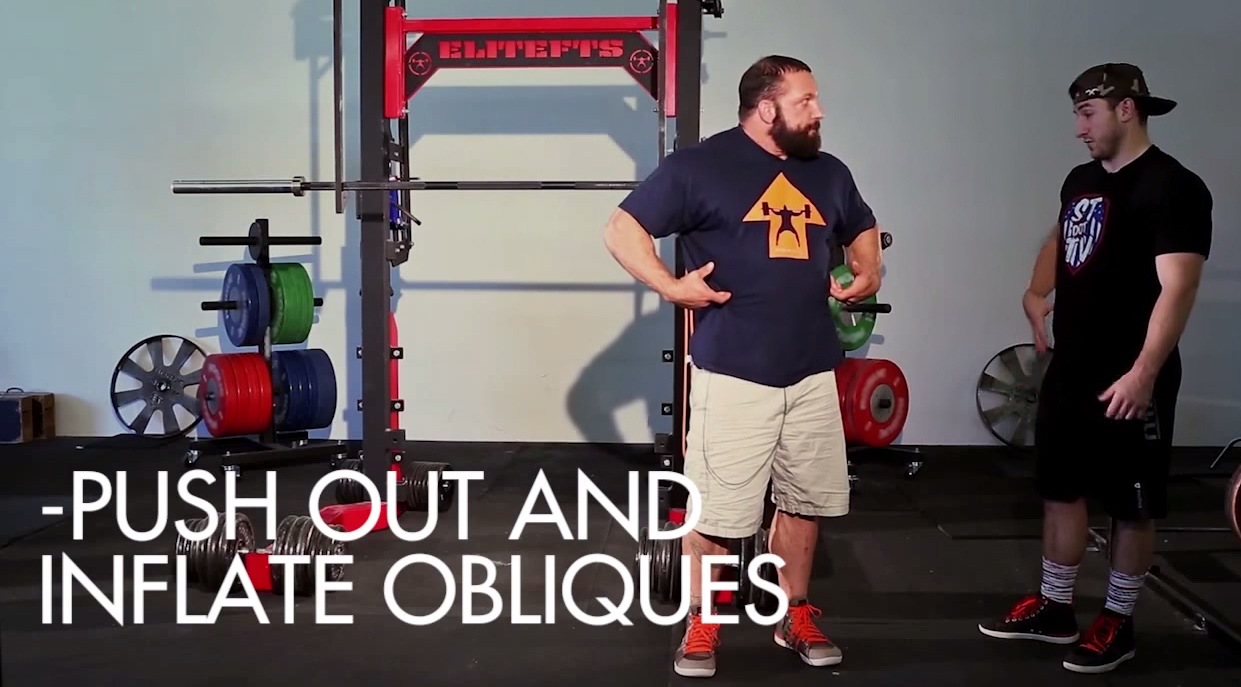
If you’re training squats, you would do some movements that require transferring power through the hip joint with a stabilized core. You would do these with proper IAP as a warm up. You would focus on ensuring that the prime movers such as the glutes are firing properly, and you would practice the cues to engage properly such as ‘rooting’ to the floor, as discussed in many of my videos. The movement selection or cueing of the movement will help with achieving proper joint centration and connecting the muscles with the properly pressurized core. Some examples are goblet squats, rear leg elevated split squats, single leg deadlifts and hip side shifts performed before squatting, as shown in one of my videos.
This movement-based approach teaches the body to turn on properly and lets the central nervous system know that it doesn’t need to down-regulate—as long as you keep proper positioning and IAP while moving to the core, heavy lift. It also gets you warmed up and ready to begin training. It’s an efficient training approach because it takes 5–10 minutes, and when you’re finished, you’re already in the process of being warmed up physically and mentally.
Read the rest of article on EliteFTS.com