
Author: Chris Duffin
Blood in the Water - by Greg Walsh
“Blood in the Water”
(If you’ve dipped your toes in the water, and like how it feels) do the favor of allowing yourself to obsess over physical performance for at least one period of your life.
I’m not talking about downing a pre-workout and moving 10% faster in a 10-minute conditioning piece… I’m talking about the non-glamorous details that lead to true advancement and markedly improved performance. Address the areas that hurt the most (pain is part of the process) and indulge the things that drive you nuts (they’re speaking to you for a reason); deep-water, high-level improvement only comes through listening to the voices you don’t want to hear.
Exception to that statement: Those fully-fueled by the act of completion of a physical task (with composition as an afterthought) or largely driven by receipt of a pat-on-the-back for simply managing to finish it; If you’re content with the shallow end, and more motivated by acclaim/ recognition than self-evaluation/ evolution, it’s better to stay out and make way for those with the mettle to jump in deep.
Very similarly to the pursuit of any type of mastery, fixation on performance requires an abandoning of convenience. Nothing about moving past what you are naturally good at, what your body is comfortable with, or what your mind has you convinced is your true potential is easy, but the closer your arm moves to the flame the more you learn about yourself. And, physically or otherwise, the more we know about, trust, and believe in ourselves the greater our chance of achieving excellence in any of our chosen paths.
It all begins with some flavor of obsession.
If our potential and capacity stay trapped in a little box wrapped and bound by convenience, fear, ego, self-deception, or even group-deception, they will forever be the prey, and never the predator. They will be the frightened child, huddled in the dark, wondering what the monster in the closet really looks like.
It doesn’t have to be profoundly unhealthy or permanent, but if we are never imbalanced in favor of tedious details and hard-earned progress, and ferociously driven by strain and struggle (and the satisfaction they bring when pushed to their limits), you will never really know which version of yourself lives at the end of that tunnel- And that is something no strong-minded person should ever die wondering.
- Greg Walsh
The Practice of Overcoming Fear
Originally posted on EliteFTS

Fear is a powerful human response, as it should be. It is our primal risk management tool that controls actions and even the nervous and hormone systems to keep us safe. Although fear is a risk management tool that keeps us safe, it can also hold us back from challenges, opportunities, and the success had from overcoming those.
You can only realize your full potential when you take risk and push yourself to your limits. There are differences in risk tolerance and ability to overcome fear between people. This difference, and one’s individual tolerance level for risk, is one of the defining things that have separated the great leaders and visionaries in history from…well, the rest of us. It is also, however, what separates those that could have been remarkable historical figures, but instead died young, lost their fortunes, or destroyed themselves in some other fashion.
Heightened reward simply comes with heightened risk and potential for failure. But if you seek to live an epic life worth writing about, the question you need to ask is, “How do I effectively improve my ability to overcome fear and improve my ability to tolerate risk?”
This means not trying to negate all response to risk, but trying to turn it into a logical decision-making process and not a primal response. Understand that fear is a primal risk-management tool that employs only your body and mind’s perception of risk without utilizing the logical thinking and analysis tools we have developed over time. As you improve your ability to overcome fear and tolerate risk, you will have to rely on these tools to take an objective look at the risk you are putting on yourself. If you are going to short circuit or dampen your natural response to risk, it does need to be replaced with something else. This way you can decide how you want to balance comfort and stability against a storybook life, but one with the potential for also ending up dead, broke, or derelict.
An example would be not having any level of fear and being challenged to a game of Russian roulette. Without fear, you may actually engage in this game. However, if you employ a little thought, you will realize that you have one in six chance of death.
Here are some methods for improving risk tolerance, organized with the easiest to employ but least effective and ending with hardest to employ but most effective:
- Logical Thought
- Specific Exposure
- Random Planned Exposure
Logical Thought
Logical thought is much like the Russian roulette example above but done in reverse. It is simply using the advanced logical thought and analysis tools to overcome the fear. It does work, proven by people jumping out of airplanes with parachutes on. Sure, there is still some level of fear but not enough to keep someone from jumping as they know that the aerodynamics of the parachute will keep them alive. We are reduced to having fear about the chute actually opening or something else going wrong. While it does work, it only works for the very specific examples and usually doesn’t stop fear as a whole around other activity.
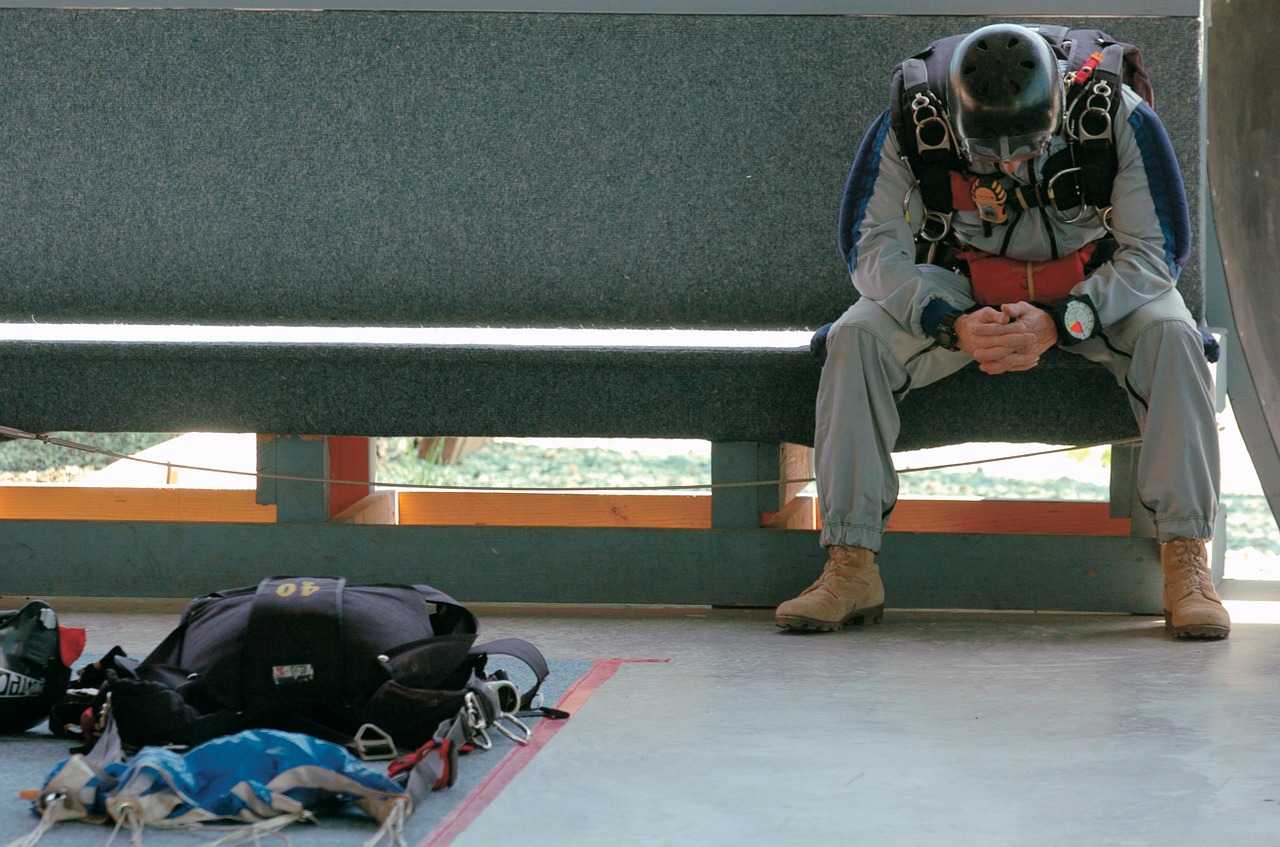
Fear is still in place and just working on a number of other levels, reducing one’s performance and ability to realize potential. Fear creates a negative spiral of thought once initiated, which consumes your mental capacity, slowing and clouding your mental and physical reactions and your decision making. This is the “what if” fear spiral. A “what if” is fear about something else going wrong.
Sure, you’re not afraid that the concepts that keep a parachute afloat will suddenly fail to work, but other fears such as getting separated from instructor, the parachute not being packed right, freezing and not pulling cord, or others come into play. Once the “what if” happens, things begin to spiral. What if I don’t complete this project on schedule, then I lose my job, then I can’t make my house payment? This is how your mind gets consumed. You’re thinking down these paths and not focused on acting to your maximal potential in the present — not realizing your potential.
Specific Exposure
Specific exposure is the next step in overcoming fear. To do this, simply expose yourself to fear repeatedly. This is very effective. Generally, overcoming a specific fear is much harder than the actual activity that you are scared of. You may be scared of speaking in public, but after doing so, you realize it was much easier than the actual stress you put yourself under leading up the that event. A favorite example of mine is that simply overcoming the fear of squatting 1000 pounds is a harder task than actually developing the ability to do so. So many things can go wrong that if you walk up to that bar without a complete lack of fear that the “what if” spiral it creates will destroy any possibility you achieving that lift.
You cannot doubt yourself if you want accomplish this task. A mind clear and focused on the task at hand and reacting at optimal speed with confidence is the only way you can pull off that lift.
RECENT Mastery of Skill: Humility and Confidence
Doubt and “what if” spirals are how fear holds you back. Specific exposure to this environment will allow you to overcome this fear, but is harder to achieve in actuality than developing the strength to do so.
Random Planned Exposure
Random planned exposure, while an oxymoron in title, is an accurate description, as you never know where the opportunities for taking risk will be in the future. You must plan on taking them, though. This is where overcoming fear becomes a practice and a part of your life.
Just like you never know where that big opportunities or overwhelming challenging will be in the future, or what it will be, you must be prepared to act when the time comes. This means you have not had the chance to apply specific exposure techniques, you must be prepared for handling fear of the unknown. To prepare you need to make a practice of finding the things that make you uncomfortable in life and jumping into them. Constantly push yourself into unknown territory as a practice. This is not something that comes naturally, as human nature is to fall into routine. Life moves on and moments of chaos and decision arise, and when this happens don’t take the easy path that allows you to not make a change and fall back into routine.
You must stay in the practice of conquering and living in the unknown. When it comes to a new job, are you going to take that job that is going to challenge you or are you going to stay with the one you can do with your eyes closed? As a shy introvert, my choice for a career in leadership and human interaction was the best thing I could have done. If you’re afraid of commitment, are you going to run away when you find someone that you think may actually be the one for you?
Never stop living life. Step outside the routines, the tasks, and choose the path of walking directly into the unknown. The unknown is the scariest place of all to step but it is the path to growth and personal achievement. Where are you right now in life and what are you doing? Are you growing? Are you finding a path through some unknown territory? If not, you need to find it or you’re just letting life live you.
Mastery of Skill: Humility and Confidence
Originally posted on EliteFTS.com
Mastery of skills, or practical knowledge, is of critical importance in the self-identity of man and, indeed, is a cornerstone of civilization. The mastery of skills allows us to create, innovate and achieve in our rapidly changing society. The creation of both tools and objects of art is one of the differentiating factors between humans and animals. Sure, there are some animals that create limited tools or works of art, but there is a clear difference in the human scope of creation. For example, in nature, specific ‘tasks’ may be passed down or the ‘art’ that the rare animal may create is biologically driven and usually just a display for the mating process. The art and tools produced by man are far more diverse and complex than anything you will find in the animal kingdom, owing to man’s rational thought and individual choice.
Mastery of a skill first requires both humility and confidence. Confidence certainly fits the generally accepted mold of the alpha male, as it should. Without confidence, we can never start the process of skill mastery and we certainly can’t hope to complete it. The question is, where and how does humility fit into this process? Without both confidence and humility, one’s ability to learn, grow and create will be severely limited. Each of these traits must be carefully balanced to maximize one’s ability to learn and contribute. Confidence will get you moving because you believe in yourself and your capabilities. This starts you on the path to a new skill. But once you jump in, you must temper that confidence and accept being humble in order to learn and master that skill. You can see this not only in the elite level of sports athletes and coaching but in nearly any other field that requires mastery of skill or knowledge. The master level is often confident but at the same time grounded and humble and always learning.
I learned these lessons in the engineering and business worlds. Some of the highest performers or highest contributors I observed weren’t necessarily the smartest people in the room. They were the ones who recognized that not only did they not have all the answers but not any one single person would. They asked the most questions or were successful in engaging all the stakeholders of a process. Their humility in accepting that they didn’t have all the answers combined with their confidence that they could get the desired results led to a high level of contribution.
As a young, highly intelligent individual, I simply wasn’t contributing at that level, as I let my confidence and cockiness in my abilities interfere with the humility I needed to grow. So I began to adopt these methods. I began asking more questions, digging further to understand the systems, asking for input, seeking mentorship and collaborating with all levels of those involved with the process. Realizing how little I knew forced me to take the action needed to exponentially grow my knowledge, understanding and skill and thus increase my results.
RECENT Using Your Body’s Mobility and Stability Mechanisms to Drive Performance
I also began employing these same concepts to my hobbies with similar effects. My skills in the fields of strength training, coaching, human movement, engineering and fabrication began accelerating. The more I sought out mentors and said “I don’t know” or “tell me more,” the more I learned and the more skilled I became.
A couple common phases that articulate this point of humility are “the day you think you know everything is the day you stop learning” and “the more you learn, the more you know that you don’t know.” Everyone has heard these phrases, but practicing and livingthem doesn’t come naturally. It usually only comes with purposeful action. Try spending a little time with most any expert in his or her respective field and you might be surprised by the context of the conversations. Sure, you will find some cocky, self-assured people, but the majority of truly knowledgeable experts are people who will offer a number of answers to the same “big picture” questions in their field. Compare this approach to that shown by relatively low level people in the field. The lower or intermediate level skilled person who wants to “display” mastery will jump at the opportunity to offer singular, definitive answers to those same questions. The inexperienced person is attempting to demonstrate to you, or possibly to himself, that he is competent and a master of his trade. By providing rigid answers without seeking additional input, he has not only proven his inexperience but his fate of never becoming a master.
Frequently, we see misdirected confidence and lack of humility in ineffective leaders. Overconfident leaders often have big dreams or ideas, but their projects invariably get derailed by the overlooked details. I imagine these leaders thinking, “I’m a big picture person. I don’t need to know the details.” The key to their failure is that they lack the knowledge to implement the idea and they lack the humility to acquire that knowledge. Some leaders will delegate the forming or implementation of their vision to their subordinates who don’t have the knowledge to analyze the effectiveness or the progress of those details. This results in a plan that can’t achieve the original vision or one that is filled with unintended costs or consequences. Even those ‘big picture’ people must know how to implement their vision. If the success of their ideas depends entirely upon the skill of their subordinates, they are abdicating their position of leadership to become a figurehead and one of no real importance to the creative process.
In order to achieve and acquire new skills, you must be confident in your actions but humble about your understanding. Display the confidence and courage to say “I can and will do this” and the humility to know that there is always a better way. I’ll leave you with Socrates’ old claim, that what he knows most assuredly is that he doesn’t know. Ignorance is also the beginning of wisdom.
Duffin Movement Systems (DMS) - Certification in NJ New York
The Duffin Movement Systems
A Complete Education on Coaching and Cueing Barbell Movements Based on Operational Mechanics vs Peripheral Observation while Learning to do a Full Movement Assessment and Corrections on the same principals
Background on this Approach
This is the only complete approach like this being taught. It is not only innovative but grounded in science pulling form multiple disciplines to create this unique system. Chris has been a competitive athlete for 25 years achieving multiple world records and 15 years of coaching. He has combined that experience with his engineering and continuous learning mindset. By seeking out and learning directly from some of the best rehab and sports clinicians around that set the course for the rest of the field, he has been able to collaborate, refine, and test this approach over the years.
In addition to his own records Chris is an even more successful coach having coached more All-Time Record setting Powerlifters than any other Coach in the world.
What you will learn
- How to coach and cue the core lifts based on operational mechanics vs peripheral observation
- How to use the core lifts as a full movement assessment
- How to then apply correction to:
- Scapular Stabilization
- Scapular to Core Integration
- Shoulder and Thoracic Mobility
- Core Stability (Proper IAP and Breathing Patterns)
- Glute & Adductor Balance and Core Integration
- Hip Mobility
- Bulletproofing the Back or Training with Disc Injuries Safely While Rehabbing
- Special exercises for developing weak areas or firing pattern issues.
- Mental preparation to achieve success as an athlete, coach, career, and life.
- Open Q&A on
- Program Organization
- Velocity Based Training
- Any other topics
DMS Certification has 2 Phases
- 2 days of intensive hands on training
- 90 day online course diving deeper than we could ever go in a 2 day weekend (Certification is not guaranteed)
The DMS Certification is for YOU, if…
- You’re finally ready to learn how to perform and coach the Power lifts the RIGHT way
- You’re tired of spinning your wheels and wasting your time
- You want a COMPLETE EDUCATION, not just another expensive piece of paper to show to your friends
- You LOVE learning and making yourself better
- You LOVE sharing what you’ve learned with others to help them become better versions of themselves, too!
Where and When?
September 26th & 27th
Potent CrossFit - 1731 Ginesi Drive, Freehold, New Jersey 07728
Register now as seating is limited!
UPDATE as of 7/12 LESS THAN 10 Seats Remaining!!!
6 month zero interest financing available Finance via paypal bill pay (US customers only). Select Paypal Credit as your checkout option to qualify.
Sign Up Here
The Art of Manliness Podcast
I recently had the opportunity to speak with Brett McKay of the Art Of Manliness. If your not familiar with this site your missing a great thing. This site is full of articles and podcast for ALL THINGS manly related with a lot of great info on important topics that have been lost in the last few generations.
The breadth of topics is awesome and always engaging and interesting. Primary categories include Dress & Grooming, Health & Sports, Manly Skills, Manly Skills, Money & Career, Relationship & Family, and a Man’s life. Don’t take my word for it, just click on the link and scroll through a few articles and you will find something that catches your interest. It is a great resource for all men and highly entertaining in a good way.
Besides posting manly topics to help curtail the emasculation of men in todays society Brett is also a lifter as well. So I couldn’t turn away his request for an interview and podcast. And as I expected it was a great time and I hope you enjoy it as well. Now if only Brett and my other favorite author on Masculinity would have Squat off….
Our conversations is recorded on this Podcast.
Westside vs The Russian Conjugate System
Article originally posted on EliteFTS.com
The author is Brandon Senn who is a trainer and member of our Coaching Team at my gym Elite Performance Center. I have worked with Brandon for a number of years and you may find him featured in some of my coaching videos as well.
Louie Simmons has been without a doubt one of the most iconic (and at times controversial) figures in the strength world over the last 20 years. Louie’s gym (Westside Barbell) has become what many people identify as the conjugate system. Westside may be synonyms with max effort, dynamic effort, repetition effort and a whole host of other special methods but is that what really makes up the conjugate system of training? Should the conjugate system and the conjugate method be used interchangeably and is Westside conjugate and Russian conjugate comparable? If you believe that the conjugate system was meant to revolve around accommodating resistance (bands/chains), a weekly micro cycle of max effort, dynamic effort, and the occasional repetition effort methods this is something you need to read.
The Birth of The Russian Conjugate System
The original conjugate system (referred to then as the coupled sequence system, CSS) was originally developed under the Dynamo umbrella of the Soviet Union in the late 60’s-early 70’s. From a macro view the CSS is a systematic development tool used to organize multi-year training. At that time for the Soviet Union that meant entering youth athletes into schools of physical preparation with the objective of identifying and developing those athletes who had potential through their careers to compete at national, and international levels. By taking a multi-year approach to training, these schools were able to thoroughly develop a general foundation of trainability general physical preparation (*spoiler alert* they didn’t sprint with a prowler until they puked to do this) and prime the adaptive response for future specific physical preparation (SPP) and intensive unidirectional loads.
For youth athletes the physical preparation schools served as a long term development tool that highly discouraged early specialization of any one sporting activity. The primary goal of the early prepatory period of an athletes career was to progressively develop motor skills and movement dynamics while sequentially developing their adaptive levels for later phases. Even though the overarching system used for athletes was the conjugate system (think long term building block development) the actual training programs of youth and lesser qualified athletes through the initial years of training would lend itself to a concurrent (multiple qualities developed at once) structure.
For qualified athletes (intermediate – advanced) who have successfully fulfilled the requirements of the early prepatory periods, a shift from concurrent training to phases of greater specificity and unidirectional loading (1 or 2 specific qualities) was made. During this period, skills gained from previous prepatory phases were not actively developed but rather maintained with maintenance levels of loading. Instead of attempting to improve the many non-specific abilities gained during the early stages of training, athletes now sought highly specific training organized to maximize competition performance and career potential. Remember, all of this is taking place over the course of many years. Depending on the qualification of the intermediate – advanced athlete they would spend the majority of their training at either end of the specificity continuum. In either instance all athletes regardless of qualification would spend time at both ends of the continuum, the only major difference being those of lesser qualification were allocated more time to developmental exercises while those of higher qualification would spend the majority of their time training highly specific exercises.
Continuum of specificity of the competition style back squat
The “System” vs. The “Method”
Without thought the conjugate system and the conjugate method are terms used to describe training variables almost always interchangeably. This is probably not the biggest issue in everyday talk but for the purposes of this article (and more technical writings in strength and performance) it will be important for us to define the terms as they do not always refer to a uniform tool. A system is a an organizational tool used in the application of training means and methods (applicable in the short and the long term). A training means is the motor ability or quality. A method is the non-motor quality training stimulus. In layman terms, a system is the overarching organization of training, a means is the specific exercise or modification to an exercise, a method is how the means is applied (sets / reps, specific training protocols, etc..).
We know from above that the intent of the conjugate “system” was to organize an athletes training at a multi-year level. The means (types of exercises) that were implemented into that system took a sequential building approach at the micro and macro level. In the early stages of training blocks athletes would train non-specific or developmental lifts that had a low-moderate correlation to the competition lifts (we will assume we are talking about lifters here). As the training block advanced and athletes neared competition only the most specific exercises that had the highest correlation to the competition lift were trained. In each exercise classification (non-specific – highly specific and every sub category between) a pool of many different exercises were utilized. This is in essence the original conjugate “method” (remember a method is not a system). The first implementation of the conjugate method was by the Soviet Olympic Weightlifting team in the early 70s. They took 20-45 SPP (specific physical preparation) exercises that were organized sequentially to build off one another towards preparation of the competition lift. These specific exercises rotated both at the micro and macro level while the frequency with which each individual exercise appeared during training was based off coaches evaluations of the athletes needs as well as the overarching continuum of specificity each athlete was placed under.
A Brief View Into The Creation of The Westside Conjugate
Jump across 5,194 miles to Culver City, CA where a young Louie Simmons is starting to make a name for himself at the original Westside Barbell Club. It’s probably not as important to dive into great detail of what Westside is/isn’t as that topic has been beaten nearly to death in the past 10 years or so. Instead we will point out only the finer details of the development of Westside Conjugate (WC). The creation of WC was by in large developed over the course of 10+ years (mid 60s-late 70s) and comprised nearly completely of trial and error. Many of the great lifters of the early 70s (Pacifico, Annelo, Crawford, etc..) have been accredited by Louie as having a major influence on his training philosophy and ultimately the original framework of WC. It wasn’t until the early 80s that Soviet sport science textbooks became available and utilized to further develop the foundation of WC. Louie has described the scope of WC as a combination of the Bulgarian and the Russian systems of training.
So Whats The Difference
Both the Russian Conjugate and Westside Conjugate rotate means (exercises or variations of) very frequently based off lifter needs and the continuum of specificity. The Russian Conjugate system seems to favor rotation of means based off lifter qualification whereas Westside appears to rotate means off immediate needs and best odds of immediate progression….
Continued on EliteFTS.com
Vision Consistency & Hardwork - Podcast Excerpts
The following video is an excerpt from a podcast I did for the SuperStrengthShow early this year. This podcast has really resonated with a lot of listeners so a teaser video was put together with an excerpt of an answer to one of my questions. While this was an off the cuff discussion for and not done with any preparation; I articulates my views and how I live my life to achieve success in all avenues. My approach to these three things is how I took myself (and much of my family) from utter poverty. From a family of 6 living on $5,000 a year and often homeless and living in the woods growing up to successful business executive & world class athlete. While growing and building a family and a future for that family.
These are three things that you can put to use in some part of your life TODAY that will yield results if executed properly.
You can listen to the full Podcast on the Super Strength Show.

Using Your Body’s Mobility And Stability Mechanisms to Drive Performance
As a performance guy, I absolutely hate the ‘traction control’ button that they put in a number of vehicles today. If you aren’t aware of what this button does, it operates by detuning the engine and, in some cases, the transmission. By retarding the engine timing to reduce its output and slowing the shift patterns, it effectively improves the traction but really no more than if you purposely stepped on the gas pedal a little softer and with better control. With less power, the detuned powertrain has less chance of losing control on an unstable surface and causing you to crash and injure yourself.
Your body has the exact same mechanisms in place. When you lack stability, your body detunes its reaction to prevent you from injuring yourself. This is the primary reason why training with a Bosu ball or squatting in squishy tennis shoes is counterproductive. With a detuned body, you simply can’t work as hard as you want to or fire and engage your muscles properly. It’s also the reason why my coaching cues help people realize immediate improvements in their lifts when implemented properly.
If you don’t have a properly stabilized core with proper intra-abdominal pressurization (IAP), this down-regulation is in place. Your traction control button is on. Another button is proper joint centration. If your positioning or tight muscles are pulling the joint to one side of the socket, it will down-regulate your central nervous system firing as well. In practice, this looks like a movement pattern-based, warm-up drill. I have several examples on my YouTube channel and further examples will be covered in depth in the Duffin Movement Series (DMS).
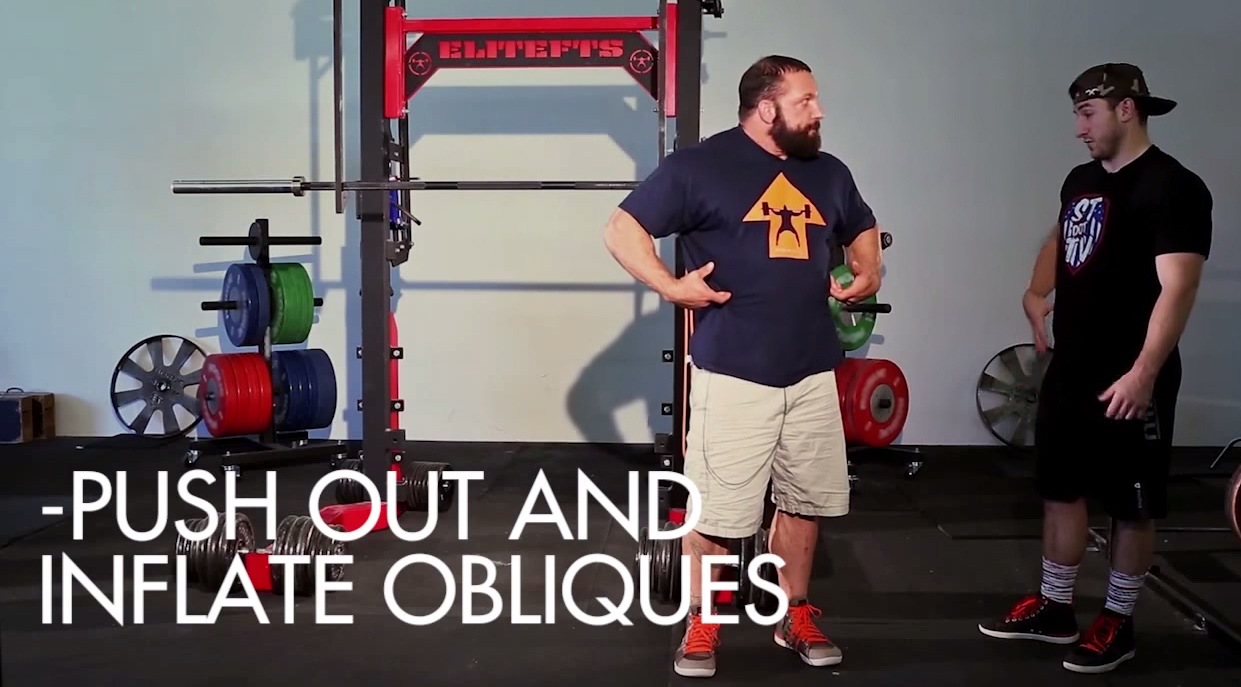
If you’re training squats, you would do some movements that require transferring power through the hip joint with a stabilized core. You would do these with proper IAP as a warm up. You would focus on ensuring that the prime movers such as the glutes are firing properly, and you would practice the cues to engage properly such as ‘rooting’ to the floor, as discussed in many of my videos. The movement selection or cueing of the movement will help with achieving proper joint centration and connecting the muscles with the properly pressurized core. Some examples are goblet squats, rear leg elevated split squats, single leg deadlifts and hip side shifts performed before squatting, as shown in one of my videos.
This movement-based approach teaches the body to turn on properly and lets the central nervous system know that it doesn’t need to down-regulate—as long as you keep proper positioning and IAP while moving to the core, heavy lift. It also gets you warmed up and ready to begin training. It’s an efficient training approach because it takes 5–10 minutes, and when you’re finished, you’re already in the process of being warmed up physically and mentally.
Read the rest of article on EliteFTS.com
SuperTotal Certification - June 13 & 14
Super Total Certification
A Complete Barbell Education for Coaches & Athletes
Powerlifting + Olympic Weightlifting = Super Total
How To Coach & Perform the Barbell Movements Better & Safer
You will learn HOW TO COACH and HOW TO PERFORM all of these lifts:
- Snatch
- Squat
- Clean
- Deadlift
- Jerk
- Bench Press
You will learn:
- How to program for ALL of them
- How to avoid (far too common) injuries in the strength sports
- How to train the ATHLETE MINDSET for optimal performance
- and a ton more….
The Super Total Certification Is For YOU, If…
- You’re finally ready to learn how to perform and coach the Olympic lifts and the Power lifts the RIGHT way
- You’re tired of spinning your wheels and wasting your time
- You want a COMPLETE EDUCATION, not just another expensive piece of paper to show to your friends
- You LOVE learning and making yourself better
- You LOVE sharing what you’ve learned with others to help them become better versions of themselves, too!
The Super Total Certification will have TWO phases:
- LIVE — A classic 2-day (all day) in-person certification. Hands-on, intense, action-packed.
- PLUS 90-DAYS — of a dedicated online COURSE designed to dive DEEP into all of the material we covered during the live event, and go further than you could ever go in only a weekend.
By Autumn of this year, you can either be a substantially better Coach & Athlete… or not. It’s up to you.
Your Teachers
Chris Duffin is the real deal!… [he] is someone I can learn from.” — Dave Tate about Chris Duffin
Chris Duffin, aka The Kabuki Warrior — Multiple-time world champion Powerlifter, Guinness World Record Holder, coach/owner/founder of Elite Performance Center, engineer, artist, loves listening to Vivaldi while lifting. He’ll be coaching the LIVE and ONLINE portion.
“Nick is one of the most underrated weightlifting coaches in the USA” — Dan Bell about Nick Horton
Nick Horton, aka The Iron Samurai — Founder of Weightlifting Academy, Coach of the Weightlifting Academy National Team, co-owner of Asheville Strength, world-famous strength & fitness writer, life-long strength athlete, mathematician, musician, loves drinking coffee while doing everything. Will be coaching LIVE and ONLINE.
“You’re both near the very top of my list of favorite people!” — Jen Sinkler on Tamara Reynolds and Nick Horton
Tamara Reynolds, aka The Ninja Manatee — Founder of Asheville Strength, national-level Olympic weightlifter, Coach of the Weightlifting Academy National Team, physical education teacher, amateur astronomer, loves “burn-your-face-off” bourbon (not while lifting). Will be coaching the Online portion.
Combined, they have coached thousands of lifters, over 4 decades, from rank beginners to top-level athletes in multiple sports. Now, you’ll learn how to do the same.
The “When & Where”
- AT: CrossFit Downtown Winston in Winston-Salem, North Carolina.
- LIVE COURSE: June 13th/14th
(The Online part of the course starts on June 22nd and goes until September 12th!)
How To Join
The Super Total Certification will eventually be OVER $1,000. But if you get in now, you save (at least) 30%!
- Tuition: One-time payment of
$1,000, Only $699 - 6-Month Payment Option: If you need a payment plan, contact Chris Duffin at [email protected]
- Scholarship: $499 — pay what you honestly can.
Click here to sign up and we’ll see you LIVE in North Carolina!
We also offer a 6 month Zero Interest financing plan
administered by Paypal Billpay
Email [email protected] get email an invoice containing a link with this option.
ShouldeRök™ How-Its-Made Video
The following video details the number or processes involved in making the ShouldeRök™. Pictures don’t do the product full justice, as any ShouldeRök™ customer will tell you. Once in your hands you will see the true craftsmanship and how it’s built to last a lifetime.
In this video you will see the ShouldeRök™ nut being cut out of raw plate on a CNC laser cutting machine. It is later put through the lathe to have the thread cut on the inside diameter and then tumbled to smooth the finish.
The next step shown in the video is the turning of the main head which is cut out of solid 3” round stock before it becomes the finished component you see. In my personal shop you will see the perfect Diamond knurl being added to the handle. Then the forming of the flare on the end of the handle, which is the final touch before the assembly is welded together in the rotary welder.
Unfortunately the plating shop didn’t allow me to get any shots of the ShouldeRök™ going into the dip tanks.
In addition to the How-Its-Made video here are a couple recent ShouldeRök™ reviews. The first one is what inspired me to use some Conan music as the background to this video. It only seemed fitting.
IMPROVE SHOULDER MOBILITY AND LOOK LIKE CONAN THE BARBARIAN
Craig Marker, Ph.D., CSCS, SFGII, is a fitness enthusiast who has spent his life trying to help people improve their lives. He is a professor at Mercer University teaching psychology and research methods.
GARAGE GYM REVIEWS - SHOULDEROK
I’ve created this site to provide honest reviews as well as instructions for DIY equipment. There is an absolutely absurd amount of equipment available for purchase today, and I will help guide you through what is worth using, and what is not.