
Category: Strength Training
Using Your Body’s Mobility And Stability Mechanisms to Drive Performance
As a performance guy, I absolutely hate the ‘traction control’ button that they put in a number of vehicles today. If you aren’t aware of what this button does, it operates by detuning the engine and, in some cases, the transmission. By retarding the engine timing to reduce its output and slowing the shift patterns, it effectively improves the traction but really no more than if you purposely stepped on the gas pedal a little softer and with better control. With less power, the detuned powertrain has less chance of losing control on an unstable surface and causing you to crash and injure yourself.
Your body has the exact same mechanisms in place. When you lack stability, your body detunes its reaction to prevent you from injuring yourself. This is the primary reason why training with a Bosu ball or squatting in squishy tennis shoes is counterproductive. With a detuned body, you simply can’t work as hard as you want to or fire and engage your muscles properly. It’s also the reason why my coaching cues help people realize immediate improvements in their lifts when implemented properly.
If you don’t have a properly stabilized core with proper intra-abdominal pressurization (IAP), this down-regulation is in place. Your traction control button is on. Another button is proper joint centration. If your positioning or tight muscles are pulling the joint to one side of the socket, it will down-regulate your central nervous system firing as well. In practice, this looks like a movement pattern-based, warm-up drill. I have several examples on my YouTube channel and further examples will be covered in depth in the Duffin Movement Series (DMS).
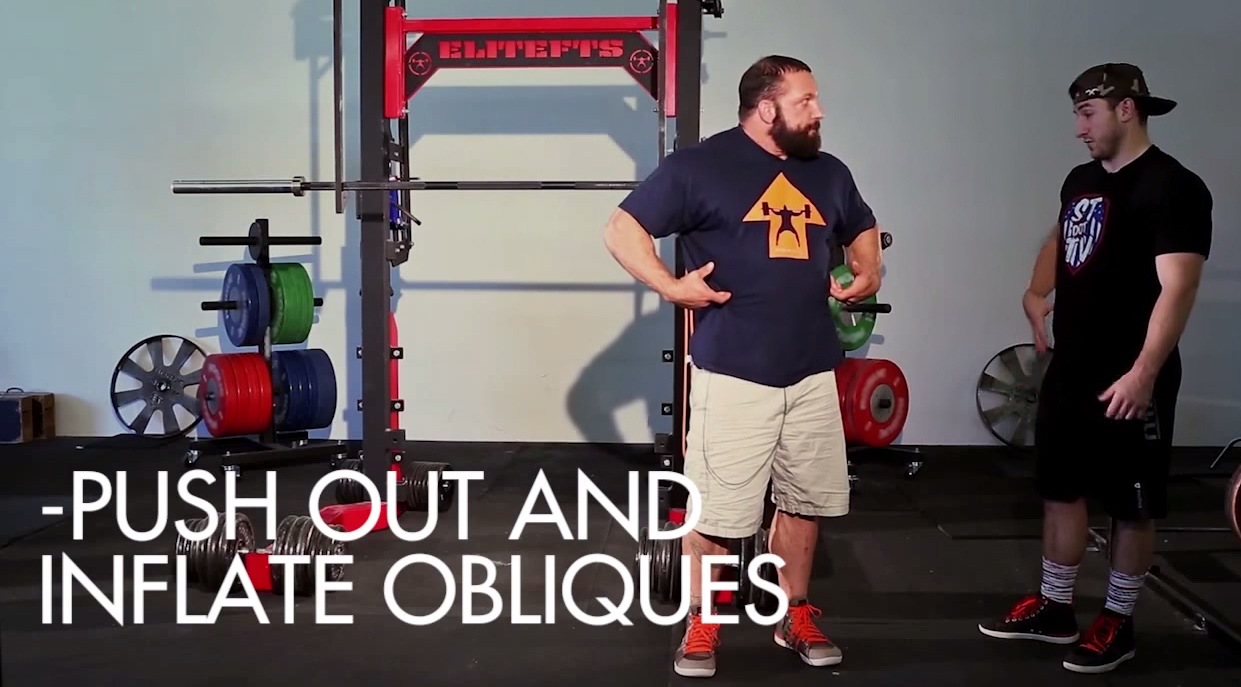
If you’re training squats, you would do some movements that require transferring power through the hip joint with a stabilized core. You would do these with proper IAP as a warm up. You would focus on ensuring that the prime movers such as the glutes are firing properly, and you would practice the cues to engage properly such as ‘rooting’ to the floor, as discussed in many of my videos. The movement selection or cueing of the movement will help with achieving proper joint centration and connecting the muscles with the properly pressurized core. Some examples are goblet squats, rear leg elevated split squats, single leg deadlifts and hip side shifts performed before squatting, as shown in one of my videos.
This movement-based approach teaches the body to turn on properly and lets the central nervous system know that it doesn’t need to down-regulate—as long as you keep proper positioning and IAP while moving to the core, heavy lift. It also gets you warmed up and ready to begin training. It’s an efficient training approach because it takes 5–10 minutes, and when you’re finished, you’re already in the process of being warmed up physically and mentally.
Read the rest of article on EliteFTS.com
SuperTotal Certification - June 13 & 14
Super Total Certification
A Complete Barbell Education for Coaches & Athletes
Powerlifting + Olympic Weightlifting = Super Total
How To Coach & Perform the Barbell Movements Better & Safer
You will learn HOW TO COACH and HOW TO PERFORM all of these lifts:
- Snatch
- Squat
- Clean
- Deadlift
- Jerk
- Bench Press
You will learn:
- How to program for ALL of them
- How to avoid (far too common) injuries in the strength sports
- How to train the ATHLETE MINDSET for optimal performance
- and a ton more….
The Super Total Certification Is For YOU, If…
- You’re finally ready to learn how to perform and coach the Olympic lifts and the Power lifts the RIGHT way
- You’re tired of spinning your wheels and wasting your time
- You want a COMPLETE EDUCATION, not just another expensive piece of paper to show to your friends
- You LOVE learning and making yourself better
- You LOVE sharing what you’ve learned with others to help them become better versions of themselves, too!
The Super Total Certification will have TWO phases:
- LIVE — A classic 2-day (all day) in-person certification. Hands-on, intense, action-packed.
- PLUS 90-DAYS — of a dedicated online COURSE designed to dive DEEP into all of the material we covered during the live event, and go further than you could ever go in only a weekend.
By Autumn of this year, you can either be a substantially better Coach & Athlete… or not. It’s up to you.
Your Teachers
Chris Duffin is the real deal!… [he] is someone I can learn from.” — Dave Tate about Chris Duffin
Chris Duffin, aka The Kabuki Warrior — Multiple-time world champion Powerlifter, Guinness World Record Holder, coach/owner/founder of Elite Performance Center, engineer, artist, loves listening to Vivaldi while lifting. He’ll be coaching the LIVE and ONLINE portion.
“Nick is one of the most underrated weightlifting coaches in the USA” — Dan Bell about Nick Horton
Nick Horton, aka The Iron Samurai — Founder of Weightlifting Academy, Coach of the Weightlifting Academy National Team, co-owner of Asheville Strength, world-famous strength & fitness writer, life-long strength athlete, mathematician, musician, loves drinking coffee while doing everything. Will be coaching LIVE and ONLINE.
“You’re both near the very top of my list of favorite people!” — Jen Sinkler on Tamara Reynolds and Nick Horton
Tamara Reynolds, aka The Ninja Manatee — Founder of Asheville Strength, national-level Olympic weightlifter, Coach of the Weightlifting Academy National Team, physical education teacher, amateur astronomer, loves “burn-your-face-off” bourbon (not while lifting). Will be coaching the Online portion.
Combined, they have coached thousands of lifters, over 4 decades, from rank beginners to top-level athletes in multiple sports. Now, you’ll learn how to do the same.
The “When & Where”
- AT: CrossFit Downtown Winston in Winston-Salem, North Carolina.
- LIVE COURSE: June 13th/14th
(The Online part of the course starts on June 22nd and goes until September 12th!)
How To Join
The Super Total Certification will eventually be OVER $1,000. But if you get in now, you save (at least) 30%!
- Tuition: One-time payment of
$1,000, Only $699 - 6-Month Payment Option: If you need a payment plan, contact Chris Duffin at [email protected]
- Scholarship: $499 — pay what you honestly can.
Click here to sign up and we’ll see you LIVE in North Carolina!
We also offer a 6 month Zero Interest financing plan
administered by Paypal Billpay
Email [email protected] get email an invoice containing a link with this option.
500lb Squat Reps PARTY! - Guinness & Tom Platz Records
I have recently decided to exit my career of 18 years advancing from engineering to executive level leadership the last 8 years. This move has been in the works a long time but its taken a lot of work to be prepared for the transition. It is a scary move leaving the comfort of a career I have excelled at and am known for my success. However I’ve reached a point in my life that I need to follow my passion and my dreams full time. I now have the opportunity to spend more time collaborating, learning, distilling, and sharing that knowledge.
My goal is to add value while continuously improving my relationship with the Strength and Conditioning Community by providing proprietary tools and knowledge designed to optimize physical and psychological human potential.
I am excited about that and making this change is worthy of an epic party to celebrate.
Of course my idea of a party is different than what most people would imagine. So before engaging in beer, booze, and food I’m going to push myself to my physical and mental limits while attempting to set records.
I’m going to be doing a 500lb squat for reps challenge. If I hit 19 reps in 60 seconds it will break the Guinness World record for best squat in a minute. If I hit 24 reps it beats an unlisted record form the 80’s when Tom Platz and Fred Hatfield went head to head for reps with 500lbs.
This will be done walked out and with only knee sleeves and belt.
Here is the link and embedded page for the live stream event!!! Please share this post around!
May 6th @ 3:30 pm PST
In the interim here is a video to get you pumped up about the event.
Rudy Kadlub, Masters Powerlifter - The Power of Thought
Rudy Kadlub, 65, co-owns Elite Performance Center in Portland, OR with business partner, Chris Duffin. It’s important that you get a sense for who he is before you put merit into his content (and you should). An American and World Record power lifter in three age divisions (22 World and 23 American/National records in four federations over a 10 year Masters career), Rudy is a former college football coach (UC Davis, University of Northern Colorado, and Boise State). He holds a master’s degree in Psychological Kinesiology from UNC where he also did his doctoral work in Sports Psychology. He’s also currently the strongest drug free 60+ Powerlifter in the world!
Today, Kadlub is a successful real estate executive and developer of not one, but two of America’s most highly acclaimed master planned communities, Orenco Station in Hillsboro, Oregon and Villebois in Wilsonville, Oregon. In addition, he recently started a commercial land brokerage business in Portland, OR.
Introduction to Topic
Sport Psychology, though not new, in theory has gained widespread practice in the past two decades. Today’s athletes and teams at all levels employ professional sports psychologists to assist in the acquisition of both fine and gross motor skills and to achieve the highest mental focus and self-confidence levels necessary to optimize physical performance.
The following is the first in a series of articles that Rudy will share with readers at KabukiWarrior.com designed to improve your ability to learn and put into use the skills necessary to reach levels of achievement you may have never dreamt possible.
An Eye on the End Game
A wise man, maybe it was Yogi Berra, once said “If you don’t know where you are going, any road will get you there.” To translate: without a goal, dream or purpose in your life you are adrift in a massive ocean in a boat without a sail or a rudder. With no end game in mind, millions of humans stumble through careers, diets, relationships and leisure time resulting in mediocre income, poor health, loneliness, and boredom.
Whatever the mind can conceive and believe, it can achieve - Napoleon Hill
The Power of Thought is immeasurably critical in the development of human behavior. Thinking about what one wants leads to an autonomic response. The thought of food may cause hunger pains or salivation, for example. Consciously bringing forth into the forefront of your mind an item one desires will set in motion both conscious and unconscious brain activity designed to help guide you in your quest. Having this goal or purpose in your thoughts lends focus to one’s actions. Philosophers, religious teachers, business authors and athletic coaches have known and preached about the secret of achievement for thousands of years yet only a small percentage of 21st century humans have learned or applied this secret to their daily lives. The simple act of thinking about something you want to acquire or want to achieve sets your mind in motion to figure out a path to do so.
If you have had success in any area of your life it likely can be said that preparation met opportunity. One quality necessary for success is having that “ definiteness of purpose”, that is, the knowledge of what one wants and developing a burning desire to possess or achieve it.
Have you ever wanted something so badly that your heart actually hurt? A new car, or a new home for example? If you wanted it badly enough, you probably put a plan together to satisfy your desire. Maybe you got a second job or sacrificed immediate gratification like those every morning grande lattes to save your money. Because you wanted it so badly you automatically started behaving in a way that would help you acquire it.
Preparing for success in sports takes more than long hours in the gym, on the track, court or field – it requires formulating your goals (consciously thinking about what you want to achieve). There are several important steps you must take in setting your goals in order to trigger the desired behavioral response.
Goal-setting is easy if you follow these simple but important steps:
- Think of your goal in an objective or Measurable Saying to yourself: I want to be slimmer, stronger or richer will not trigger behavioral change. You must be definite in your goals. For example, stating “I want to weigh ___lbs.” or “I want to be able to squat or bench ___lbs., or even “I want to have $____.00 in the bank” (plug in your own numbers) are definitive, measurable goals.
- Make the goal challenging but Attainable. It is critical to your success that you set lofty goals so that you are stretching yourself, but reasonable enough so you do not become frustrated with failure of what is improbable. If you are a 175lb strength athlete, for example, you might set a challenging goal to bench press 1.5 times your body weight (BW), then after accomplishing that resetting to 300lbs, then even 2X or 3X BW. However, setting an initial goal of say 700lbs would likely just lead to failure and discouragement.
- Set a definite but realistic Timeframe for achieving your goal. Give yourself enough time to work your plan but not so long that you procrastinate the plan’s implementation. Write down a definitive date on which you plan to achieve your goals.
- Put together a Plan for success. Write your goals down and keep them in a convenient place so you can review them daily. Keeping your goals in the forefront of your mind is key to keeping you on track. Lay out a ‘step-by-step’ plan to guide yourself. The plan should include daily, weekly, monthly, and annual actions that you will take in pursuit of your goal(s). Write your plan down, keep them with your written goals and refer to them daily to be sure you are behaving according to your plan.
- Picture yourself as already in possession of the goal. You must develop a belief mechanism in order for goal-setting to function properly. If you don’t believe-you won’t achieve. Mental imagery is one of the best ways to accomplish this. Take a second right now to picture yourself already in possession of/performing the goal. If you set a weight loss goal, for example, picture yourself at your perfect body weight. We will delve into this technique in detail in future articles.
- Develop a burning Desire. The difference often times between those who succeed and those who do not is the passion of the goal-setter. Some people only make a wish, cross their fingers and hope it comes true. In the world of successful people, however, you will find that they have developed a burning desire to achieve their goal and will not give up or be deterred until it is achieved. Also-rans give up at the first sign of failure or setback, but the champion will not be denied. He or she will push through injury, minor setbacks or failure until the goal is achieved because of their unrelenting desire for accomplishment.
- Share your goal only within your Circle of Trust. Be careful to share your goal(s) only with those who truly share you beliefs. A simple comment by a spouse or friend such as “I’d still be proud of you if you just did half of that” may undermine your belief system or erode your passion.
Are you ready to improve and change your life? If so, don’t procrastinate another minute. Take the time right now to start thinking your way to success. Envision your new self, write down measurable, challenging, time-certain goals. Next, write down your daily/weekly/annual plan. Remind yourself everyday how much you want it. See yourself as already having achieved the goal in order to solidify your belief system, then share it only with your Inner Circle-the people you know believe in you. If you don’t have someone, you can share it with me because I believe that ‘whatever the mind can conceive and believe it can achieve’.
-Rudy ([email protected])
The ShouldeRök™ versus a Macebell or Gada

The Macebell or Gada is a classical training tool dating back centuries. Its original use was in the wrestling for fighting cultures of ancient Persia and India. My first experience using one was about 8 years ago when I attempted to incorporate it for shoulder development and conditioning. As a competitive powerlifter I quickly abandoned its use finding that combined with my powerlifting training it aggravated my wrist, elbows, and shoulders.
However 2 years ago I decided to make another run at using the macebell again. I had been making tremendous gains in shoulder health and mobility with my progression into Dynamic Neuromuscular Stabilization (DNS) and some associated kettlebell work. I decided to try the swing again but focus on some refinement in the movement based on the DNS methodologies. The goal was to simply realize some training efficiency as the swing was a very active warmup. If I could accomplish my rehab, prehab, and warmup all at the same time I would have more time to focus on my actual training.
With the new approach to the swing my shoulder pain that I had been experiencing daily for the last 8 years disappeared after the first 30 days. This is pain that had kept me from sleeping, interfered with my training, and I was only able to manage in the short term with mobilizing and re-seating drills. Gone! I couldn’t believe the change. Being surrounded by powerlifters and strongman I found several other test subjects similar to myself and quickly found that the same thing happened. That was when I decided to develop the tool into what we now are marketing to others as the ShouldeRök™. For further details on the value of the ShouldeRök™ and its impact on eliminating issues caused by open chain barbell movements today done with an open scissor you can watch this video of me presenting on the topic to a room full of clinical rehab specialist.
One of key differentiating features is the easy load ability combined with the length of the product. Most products of this type are shorter which allows for the same weight to be used across a broader spectrum. This approach compromises effectiveness effectiveness of their products but is required for those selling ‘fixed bells’. The length of the ShouldeRök™ is designed to maximize balance as well as the eccentric opening and the requirements for muscle engagement and stability. The ShouldeRök™ is simply a superior product for this reason.
A lot of people regard this as a mobility tool and they are really missing the boat as to the true value it provides. Mobility is an output but it is achieved through developing strength and stability with the proper integration of shoulder to core interactions. The strength and stability are achieved with the proper cueing patterns and core stabilization while applying dynamic load as the shoulder moves through its entire range of motion. In addition all the supporting muscles of the shoulder girdle are engaged and develop particularly as you add progressive load. The ShouldeRök™ and ShouldeRök™ method provide strength development, improve stability and shoulder to core integration, and increase mobility. These improvements are made all with the use of a fun and highly efficient warmup or cool down to any workout.
Over the next year and a half after realizing these changes in my shoulder health I continued to refine the DNS inspired cues and approach to the swing. I also put on my engineering hat and decided to improve the product itself. I lengthened the bell and improved the balance with proper material selection giving it a very unique swing characteristic compared to others on the market. We had some shot loadable bells in the gym but it was such a pain to change the weight that it was never done. With micro-loading progression and small weight differences making a big impact between one athlete to the next I felt that changing weights quickly was a critical piece. I chose to have it plate loadable with Olympic plates. This allowed for developing a loading method that would ensure the safety of the lifter and those around them. Having a weight fly off the end of a bell just wasn’t acceptable, or compromising the proper handle size to use 1” plates. For comfort and control I added knurling and flaring of the handle. The handle has 14″ of flaring so that shorter lifters can choke up on the handle and use it as a shorter device.
The ShouldeRök™ was branded as a separate product than just a macebell due to the unique nature of the specific coaching cues that are provided to customers and significant design refinement of the product. It is simply the best product of its type on the market and video series with it was developed by one of the best strength athletes and strength coaches in the world today.
It’s time to get strong! Its time to get your ShouldeRök™ today!
ADDENDUM - Recent Reviews
IMPROVE SHOULDER MOBILITY AND LOOK LIKE CONAN THE BARBARIAN
Craig Marker, Ph.D., CSCS, SFGII, is a fitness enthusiast who has spent his life trying to help people improve their lives. He is a professor at Mercer University teaching psychology and research methods.
GARAGE GYM REVIEWS – SHOULDEROK
I’ve created this site to provide honest reviews as well as instructions for DIY equipment. There is an absolutely absurd amount of equipment available for purchase today, and I will help guide you through what is worth using, and what is not.
Chris Duffin Q&A with Mark Bell and SuperTraining Gym visit
Last week I took a trip to visit my friend Mark Bell at his new facility. We had a great time shooting interviews, podcast, and some great instructional pieces I did with some of his athletes. I’m looking forward to these pieces coming available on the public domain for you to see in the coming weeks.
On the last day before catching a flight out of town we decided to do a quick Q&A from the social media following and posted up request to questions just before the final workout of the visit. Unfortunately there were so many questions that came in we were barely able to get to a fraction of them, but hope that you enjoy the ones we were able to get to.
Additionally here is the workout video for last week which covers the time at SuperTraining.
Powerlifting Legend Ed Coan and Chris Duffin Talk Shop
This weekend I had the opportunity to spend a couple full days working with Ed Coan. We had a great deal of success in working through some issues he has and establishing a path forward. During the time we also had a lot of back and forth knowledge sharing.
It was a tremendous honor for me to host Ed for the weekend at EPC in Portland and to have his trust for seeking me out. At the end of the period we filmed an incredible interview covering a number of great topics that I think are worth the watch. Make sure to check out the ShouldeRök™ Ed mentioned and subscribe to our newsletter for weekly insights.
Wide Stance Groin Health - Passive Compression | Hip Airplane | Targeted Volume
In December of 2012 I tore my right adductor in a meet. I had actually had some minor tearing early in the year and had been managing it to keep training but with a 782 competition squat it let go on me.
After rehabbing the area I determined a need to reduce my injury risk. With squatting wide and pulling sumo it simply puts a lot of strain on this area that is sometimes slow to recover. It is also a faily common injury point with lifters.
One of the ways I have reduced this risk is with ensuring proper recruitment patterns are firing before this heavy eccentric load. This is done with a specific warmup routine and test-retest methodology before jumping under squats. I reviewed this warmup routine on Breaking Muscle.
That write up only covered that specific warmup and also skipped the hip-airplane that I often employ as part of it.
In this video piece I go into depth on the hip-aiprlane that is used before I squat and pull but also passive compression and some targeted volume work. The passive compression can make an instantaneous improvement if you have some issues in this area and also seems to improve recovery as well as reduce injury risk. I employ passive compression in training on pretty much every heavy set for this reason. A hammy band or a compression band work great. In addition to the passive compression it’s great to work in some volume work to stimulate flushing of this low blood flow area. An example of this is provided in the video as well.
This is not the be all and end all of groin health, but just the methods I have employed with success. It has allowed me to successfully move from that failed squat at the beginning to the standing world record 881 squat 2 years later with no aggravation of this injury.
“The Mad Scientist of Powerlifting”? Stan Efferding w/Chris Duffin
Last weekend I took a trip to Las Vegas and worked with my friend Stan Efferding (Worlds Strongest Bodybuilder) and also Eric Spoto (worlds strongest raw bench presser). I have been working with Eric Spoto on his rotator cuff surgery rehab plan over the last several months. Eric has been working with his physical therapist on his rehab plan while I was guiding him on his training in the gym and other recuperative movements that fell within those parameters. With Eric’s progress he had reached a point that we could begin incorporating the ShouldeRok to deal with some of the root issues that could have led to his surgery to begin with. It was time to build the platform for ongoing strength and shoulder health for his continued dominance in the bench press, prompting this trip.
Upon learning that I was coming down I received a text from Stan asking if I could help him dial in some changes to his deadlift. At least the text was sent to my phone, but I was confused as he was referencing the “mad scientist” for assistance. Upon arriving at the Iron House gym Stan cleared up that he was indeed talking about me, as you will see in the following video. Upon reflection the nickname is fitting given my tendency to tinker with and improve everything including my machining, 4 wheeling rigs, gym devices, and human movement.
Don’t worry the actual coaching videos will follow in coming weeks: “The Mad Scientist of Powerlifting”? Stan Efferding w/Chris Duffin
Increase Work Capacity (without Losing Strength)
Originally posted on EliteFTS.com
The following program is built to rapidly grow one’s work capacity while maintaining strength. There will still be gains in strength at this time but the goal is to make substantial gains in work capacity without sacrificing strength, as often happens. It may take a full cycle to ramp up to where you are able to work at full capacity as written in the Week 1-3 phase.
To do this, use smaller loads on the prowler, grappler, swings, or reps on the rope so that you can complete the entire HIIT session. Then over the first three weeks of the cycle, ramp these loads up as your capacity increases. In following cycles your goal is to start at that higher load immediately at week one and maintain through week three. From there, use the same weights/reps/time-on but cycle down as prescribed by dropping circuits or sessions.
[Editor’s Note: The information you see on this piece of paper is straight from the mind of Chris Duffin. Dave gave Chris a call one afternoon and asked that he help contribute to the Make-A-Wish Holiday Manuals. Immediately, and without pause, Chris sat down and recorded the precise methods he has used to help himself and other lifters at Elite Performance Center. There is no second-hand recreation or low-level journalism tactics to make this appealing. It is simply the thoughts of an all-time world record holder.]
Here is some more information about how I usually train. Based on the above workout and the basic tenants of my training methods, you can get a good idea of how you can put these techniques to use.
- The most important thing for any lifter (0:07)
- Duffin’s training protocol (0:25)
- How and why does Duffin measure the speed of trainings lifts? (3:05)
- How does Duffin adjust his training parameters based on the speed of his lifts? (5:06)
- How do Duffin’s training methods change when in preparation for a meet? (6:36)
- What allows Duffin to recover from heavy training more easily than most lifters are able? (8:12)
- How Duffin coaches at Elite Performance Center (9:53)