
Tag: duffin
Vision Consistency & Hardwork - Podcast Excerpts
The following video is an excerpt from a podcast I did for the SuperStrengthShow early this year. This podcast has really resonated with a lot of listeners so a teaser video was put together with an excerpt of an answer to one of my questions. While this was an off the cuff discussion for and not done with any preparation; I articulates my views and how I live my life to achieve success in all avenues. My approach to these three things is how I took myself (and much of my family) from utter poverty. From a family of 6 living on $5,000 a year and often homeless and living in the woods growing up to successful business executive & world class athlete. While growing and building a family and a future for that family.
These are three things that you can put to use in some part of your life TODAY that will yield results if executed properly.
You can listen to the full Podcast on the Super Strength Show.

Using Your Body’s Mobility And Stability Mechanisms to Drive Performance
As a performance guy, I absolutely hate the ‘traction control’ button that they put in a number of vehicles today. If you aren’t aware of what this button does, it operates by detuning the engine and, in some cases, the transmission. By retarding the engine timing to reduce its output and slowing the shift patterns, it effectively improves the traction but really no more than if you purposely stepped on the gas pedal a little softer and with better control. With less power, the detuned powertrain has less chance of losing control on an unstable surface and causing you to crash and injure yourself.
Your body has the exact same mechanisms in place. When you lack stability, your body detunes its reaction to prevent you from injuring yourself. This is the primary reason why training with a Bosu ball or squatting in squishy tennis shoes is counterproductive. With a detuned body, you simply can’t work as hard as you want to or fire and engage your muscles properly. It’s also the reason why my coaching cues help people realize immediate improvements in their lifts when implemented properly.
If you don’t have a properly stabilized core with proper intra-abdominal pressurization (IAP), this down-regulation is in place. Your traction control button is on. Another button is proper joint centration. If your positioning or tight muscles are pulling the joint to one side of the socket, it will down-regulate your central nervous system firing as well. In practice, this looks like a movement pattern-based, warm-up drill. I have several examples on my YouTube channel and further examples will be covered in depth in the Duffin Movement Series (DMS).
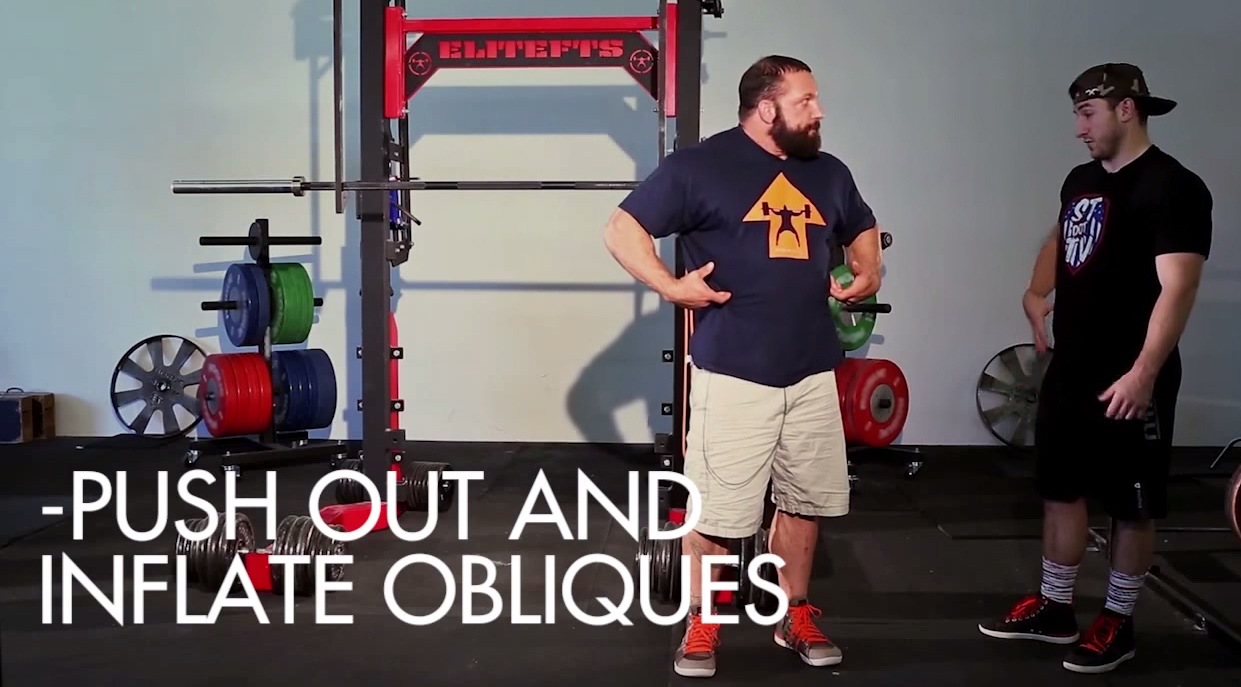
If you’re training squats, you would do some movements that require transferring power through the hip joint with a stabilized core. You would do these with proper IAP as a warm up. You would focus on ensuring that the prime movers such as the glutes are firing properly, and you would practice the cues to engage properly such as ‘rooting’ to the floor, as discussed in many of my videos. The movement selection or cueing of the movement will help with achieving proper joint centration and connecting the muscles with the properly pressurized core. Some examples are goblet squats, rear leg elevated split squats, single leg deadlifts and hip side shifts performed before squatting, as shown in one of my videos.
This movement-based approach teaches the body to turn on properly and lets the central nervous system know that it doesn’t need to down-regulate—as long as you keep proper positioning and IAP while moving to the core, heavy lift. It also gets you warmed up and ready to begin training. It’s an efficient training approach because it takes 5–10 minutes, and when you’re finished, you’re already in the process of being warmed up physically and mentally.
Read the rest of article on EliteFTS.com
SuperTotal Certification - June 13 & 14
Super Total Certification
A Complete Barbell Education for Coaches & Athletes
Powerlifting + Olympic Weightlifting = Super Total
How To Coach & Perform the Barbell Movements Better & Safer
You will learn HOW TO COACH and HOW TO PERFORM all of these lifts:
- Snatch
- Squat
- Clean
- Deadlift
- Jerk
- Bench Press
You will learn:
- How to program for ALL of them
- How to avoid (far too common) injuries in the strength sports
- How to train the ATHLETE MINDSET for optimal performance
- and a ton more….
The Super Total Certification Is For YOU, If…
- You’re finally ready to learn how to perform and coach the Olympic lifts and the Power lifts the RIGHT way
- You’re tired of spinning your wheels and wasting your time
- You want a COMPLETE EDUCATION, not just another expensive piece of paper to show to your friends
- You LOVE learning and making yourself better
- You LOVE sharing what you’ve learned with others to help them become better versions of themselves, too!
The Super Total Certification will have TWO phases:
- LIVE — A classic 2-day (all day) in-person certification. Hands-on, intense, action-packed.
- PLUS 90-DAYS — of a dedicated online COURSE designed to dive DEEP into all of the material we covered during the live event, and go further than you could ever go in only a weekend.
By Autumn of this year, you can either be a substantially better Coach & Athlete… or not. It’s up to you.
Your Teachers
Chris Duffin is the real deal!… [he] is someone I can learn from.” — Dave Tate about Chris Duffin
Chris Duffin, aka The Kabuki Warrior — Multiple-time world champion Powerlifter, Guinness World Record Holder, coach/owner/founder of Elite Performance Center, engineer, artist, loves listening to Vivaldi while lifting. He’ll be coaching the LIVE and ONLINE portion.
“Nick is one of the most underrated weightlifting coaches in the USA” — Dan Bell about Nick Horton
Nick Horton, aka The Iron Samurai — Founder of Weightlifting Academy, Coach of the Weightlifting Academy National Team, co-owner of Asheville Strength, world-famous strength & fitness writer, life-long strength athlete, mathematician, musician, loves drinking coffee while doing everything. Will be coaching LIVE and ONLINE.
“You’re both near the very top of my list of favorite people!” — Jen Sinkler on Tamara Reynolds and Nick Horton
Tamara Reynolds, aka The Ninja Manatee — Founder of Asheville Strength, national-level Olympic weightlifter, Coach of the Weightlifting Academy National Team, physical education teacher, amateur astronomer, loves “burn-your-face-off” bourbon (not while lifting). Will be coaching the Online portion.
Combined, they have coached thousands of lifters, over 4 decades, from rank beginners to top-level athletes in multiple sports. Now, you’ll learn how to do the same.
The “When & Where”
- AT: CrossFit Downtown Winston in Winston-Salem, North Carolina.
- LIVE COURSE: June 13th/14th
(The Online part of the course starts on June 22nd and goes until September 12th!)
How To Join
The Super Total Certification will eventually be OVER $1,000. But if you get in now, you save (at least) 30%!
- Tuition: One-time payment of
$1,000, Only $699 - 6-Month Payment Option: If you need a payment plan, contact Chris Duffin at [email protected]
- Scholarship: $499 — pay what you honestly can.
Click here to sign up and we’ll see you LIVE in North Carolina!
We also offer a 6 month Zero Interest financing plan
administered by Paypal Billpay
Email [email protected] get email an invoice containing a link with this option.
The ShouldeRök™ versus a Macebell or Gada

The Macebell or Gada is a classical training tool dating back centuries. Its original use was in the wrestling for fighting cultures of ancient Persia and India. My first experience using one was about 8 years ago when I attempted to incorporate it for shoulder development and conditioning. As a competitive powerlifter I quickly abandoned its use finding that combined with my powerlifting training it aggravated my wrist, elbows, and shoulders.
However 2 years ago I decided to make another run at using the macebell again. I had been making tremendous gains in shoulder health and mobility with my progression into Dynamic Neuromuscular Stabilization (DNS) and some associated kettlebell work. I decided to try the swing again but focus on some refinement in the movement based on the DNS methodologies. The goal was to simply realize some training efficiency as the swing was a very active warmup. If I could accomplish my rehab, prehab, and warmup all at the same time I would have more time to focus on my actual training.
With the new approach to the swing my shoulder pain that I had been experiencing daily for the last 8 years disappeared after the first 30 days. This is pain that had kept me from sleeping, interfered with my training, and I was only able to manage in the short term with mobilizing and re-seating drills. Gone! I couldn’t believe the change. Being surrounded by powerlifters and strongman I found several other test subjects similar to myself and quickly found that the same thing happened. That was when I decided to develop the tool into what we now are marketing to others as the ShouldeRök™. For further details on the value of the ShouldeRök™ and its impact on eliminating issues caused by open chain barbell movements today done with an open scissor you can watch this video of me presenting on the topic to a room full of clinical rehab specialist.
One of key differentiating features is the easy load ability combined with the length of the product. Most products of this type are shorter which allows for the same weight to be used across a broader spectrum. This approach compromises effectiveness effectiveness of their products but is required for those selling ‘fixed bells’. The length of the ShouldeRök™ is designed to maximize balance as well as the eccentric opening and the requirements for muscle engagement and stability. The ShouldeRök™ is simply a superior product for this reason.
A lot of people regard this as a mobility tool and they are really missing the boat as to the true value it provides. Mobility is an output but it is achieved through developing strength and stability with the proper integration of shoulder to core interactions. The strength and stability are achieved with the proper cueing patterns and core stabilization while applying dynamic load as the shoulder moves through its entire range of motion. In addition all the supporting muscles of the shoulder girdle are engaged and develop particularly as you add progressive load. The ShouldeRök™ and ShouldeRök™ method provide strength development, improve stability and shoulder to core integration, and increase mobility. These improvements are made all with the use of a fun and highly efficient warmup or cool down to any workout.
Over the next year and a half after realizing these changes in my shoulder health I continued to refine the DNS inspired cues and approach to the swing. I also put on my engineering hat and decided to improve the product itself. I lengthened the bell and improved the balance with proper material selection giving it a very unique swing characteristic compared to others on the market. We had some shot loadable bells in the gym but it was such a pain to change the weight that it was never done. With micro-loading progression and small weight differences making a big impact between one athlete to the next I felt that changing weights quickly was a critical piece. I chose to have it plate loadable with Olympic plates. This allowed for developing a loading method that would ensure the safety of the lifter and those around them. Having a weight fly off the end of a bell just wasn’t acceptable, or compromising the proper handle size to use 1” plates. For comfort and control I added knurling and flaring of the handle. The handle has 14″ of flaring so that shorter lifters can choke up on the handle and use it as a shorter device.
The ShouldeRök™ was branded as a separate product than just a macebell due to the unique nature of the specific coaching cues that are provided to customers and significant design refinement of the product. It is simply the best product of its type on the market and video series with it was developed by one of the best strength athletes and strength coaches in the world today.
It’s time to get strong! Its time to get your ShouldeRök™ today!
ADDENDUM - Recent Reviews
IMPROVE SHOULDER MOBILITY AND LOOK LIKE CONAN THE BARBARIAN
Craig Marker, Ph.D., CSCS, SFGII, is a fitness enthusiast who has spent his life trying to help people improve their lives. He is a professor at Mercer University teaching psychology and research methods.
GARAGE GYM REVIEWS – SHOULDEROK
I’ve created this site to provide honest reviews as well as instructions for DIY equipment. There is an absolutely absurd amount of equipment available for purchase today, and I will help guide you through what is worth using, and what is not.
Chris Duffin Q&A with Mark Bell and SuperTraining Gym visit
Last week I took a trip to visit my friend Mark Bell at his new facility. We had a great time shooting interviews, podcast, and some great instructional pieces I did with some of his athletes. I’m looking forward to these pieces coming available on the public domain for you to see in the coming weeks.
On the last day before catching a flight out of town we decided to do a quick Q&A from the social media following and posted up request to questions just before the final workout of the visit. Unfortunately there were so many questions that came in we were barely able to get to a fraction of them, but hope that you enjoy the ones we were able to get to.
Additionally here is the workout video for last week which covers the time at SuperTraining.
Wide Stance Groin Health - Passive Compression | Hip Airplane | Targeted Volume
In December of 2012 I tore my right adductor in a meet. I had actually had some minor tearing early in the year and had been managing it to keep training but with a 782 competition squat it let go on me.
After rehabbing the area I determined a need to reduce my injury risk. With squatting wide and pulling sumo it simply puts a lot of strain on this area that is sometimes slow to recover. It is also a faily common injury point with lifters.
One of the ways I have reduced this risk is with ensuring proper recruitment patterns are firing before this heavy eccentric load. This is done with a specific warmup routine and test-retest methodology before jumping under squats. I reviewed this warmup routine on Breaking Muscle.
That write up only covered that specific warmup and also skipped the hip-airplane that I often employ as part of it.
In this video piece I go into depth on the hip-aiprlane that is used before I squat and pull but also passive compression and some targeted volume work. The passive compression can make an instantaneous improvement if you have some issues in this area and also seems to improve recovery as well as reduce injury risk. I employ passive compression in training on pretty much every heavy set for this reason. A hammy band or a compression band work great. In addition to the passive compression it’s great to work in some volume work to stimulate flushing of this low blood flow area. An example of this is provided in the video as well.
This is not the be all and end all of groin health, but just the methods I have employed with success. It has allowed me to successfully move from that failed squat at the beginning to the standing world record 881 squat 2 years later with no aggravation of this injury.
Whiskey & Deadlifts
Whiskey & Deadlifts
(aka - Powerlifting: Experimentation and Logic behind Intra-Workout Alcohol Consumption)
by powerlifter Chris Duffin
Are you looking for an excuse to get drunk or abuse alcohol? If yes than go away! This is most definitely not an article for you. Without a doubt the negative long term and short term effects of alcohol are very well documented. Particularly as an athlete, excess and even moderate alcohol use can have a detrimental effect on your powerlifting and strongman performance. From negative hormonal factors such as lowering testosterone, lowering HGH, lowering ADP generation, and increasing cortisol to dietary impacts of reducing protein syntheses, containing 7cal/g of energy, and interfering with absorption of other nutrients - all of these factors make it clear that alcohol is something to avoid as a strength athlete (or consume in very minimal quantities). The short term depressant effect, slowing both cognitive ability as well as coordination, and reducing decision making abilities makes it hard to understand how there would be any value in alcohol at all – particularly when it comes to strength sports.
Unfortunately for us, much of the research we have access to is incomplete. It looks at the short term and long term effects of alcohol on the body. There is plenty of positive research on minimal to moderate long-term alcohol use and the positive effects on cardiovascular health and free radical scavenging properties – This might be something for us to explore at another time.
The exception and interesting thing to note is in the lack of research on the IMMEDIATE effects of low-dose alcohol consumption on the athlete.
The proposed hypothesis is that alcohol used in small and properly timed doses allows for harnessing some of the immediate psychoactive effects that can have a net positive impact on performance. Before reading further I would like to state that the use of alcohol is banned by WADA (World Anti-Doping Agency), so if you are thinking of using it in tested competitive events – please don’t. Interestingly enough, the very first athlete to be disqualified from the Olympic Games was for alcohol use at 1968 games in Mexico City (Hans-Grunner Liljenwall). This was only one year following the death of Tom Simpson, a Tour de France athlete that died from excessive use of Brandy and Amphetamines during the race. It was this 1967 death that caused the IOC (International Olympic Committee) to kick off its anti-doping efforts. The use of alcohol in athletics has been around for some time. How long exactly is a historical mystery, but it is well documented that the challenging 1904 Olympic Marathon was won by Thom Hicks who was ready to give up at the 16mile mark due to exhaustion. After that point, at every stop his handlers gave him brandy for recovery and he went on to finish and win the race. The ancient Greeks in the original Olympic Games used a number of psychoactive drugs, including wine consumption, to enhance performance. Even today many Russian strength athletes are rumored to enjoy drinking vodka before deadlifting. I believe this is not just because they like vodka but the actual immediate performance enhancing effects.
To explain my logic I invite you to first imagine a scenario that many may be familiar with – an individual in a bar. In that bar you notice someone at another table you find very attractive and want to strike up a conversation with, but most of us in this classic scenario are nervous. You friend suggests you have a shot of “liquid courage”. Yes, we know some of the positive psychoactive effects of alcohol from our own experiences without having to see any hard research. That quick shot of liquid courage does several things – first, it reduces inhibition and fear, then it can also shut down the many thoughts that run through your mind; thoughts of second-guessing yourself and of overthinking the situation. It quiets the mind and calms the nerves – effectively reducing anxiety in the short term. One interesting anecdote is that alcohol is banned in the sport of competitive shooting for exactly these reasons. Alcohol can be a performance enhancer that can reduce tremors, improve balance (yes…immediate but not long term), and thus ultimately improving accuracy. In addition to calming the nerves, reducing inhibition, and reducing fear, it also heightens whatever mood you’re in – including aggression or sociability.
While alcohol is listed as a depressant it is an interesting drug in that that it can also have stimulant-like effects. Part of this effect may or may not be related to the fast acting metabolic action it has as a calorically-dense substance. Alcohol absorbs faster than simple carbohydrates yet has almost the same caloric density as fats while also being absorbed and used by the body with a higher priority than the other macronutrients. This may not be what causes stimulant like effects under some conditions, but it certainly has an impact as an on-demand intra-workout calorie source. Think back to the recovery of that marathon runner. We can anecdotally guess that if he had used alcohol before the race it would have had a negative impact on his performance. But in this specific application it was effective in the immediate, short term as an intra-workout energy source.
Additionally, alcohol has an immediate hypertensive effect on the heart – it effectively causes blood pressure to increase. While this effect is not typically considered beneficial, short-term spikes in blood pressure can make heavy weights feel lighter. Elevated blood pressure, reduced fear, less jitters/tremors, more focus (shutting down the overthinking mind), mood enhancement, reduced pain perception, fast absorbing caloric energy it is easy to now see how this popular psychoactive drug can be used as a specific targeted tool by which athletes can improve performance. As long as the amounts are kept to an absolute minimum - mitigating both the short term and long term negative effects – it is not a far reach at all to consider alcohol as a performance enhancer, particularly for strength athletes.
Due to the negative short term and long-term effects of alcohol its use in training should be very limited; perhaps saved for that heavy Squat or Bench Press PR when you need an extra boost. Think about being at the bar and having walked up and started a conversation with that person. With a shot or two in you, you are likely unaffected, have your wits about you, and can engage this person successfully. However, if you continue to drink, everything is going to go downhill quickly as you become inebriated. In the gym it needs to be the same way - a shot or two before that big lift of the week (or month) is all that is needed. Harness that big PR set and take it a step farther next time.
What you don’t want to do is to negatively affect the rest of your workout, the next days training, or your recovery in any way. As the Russians are rumored to do, it also seems wise to only use alcohol as a performance enhancer for movements you can walk away from – the deadlift being a perfect example. You don’t want to get stuck under a squat or bench because of reduced coordination, even if this isn’t likely with the amounts we’ve discussed. Additionally, if you chose to use this substance for performance enhancement at a (non-tested) powerlifting meet, you wouldn’t want to drink before squats or bench as this would leave you with the negative effects later in the day on the subsequent lifts.
I have only been experimenting with timing and amounts of alcohol in training for the last month or so. As suggested above, I have only done this on deadlift days. Currently I am deadlifting twice a week, and that puts me at 2-4 shots a week. I have found a shot 2-3min before my last pull to be most effective. Sometimes it is before the last two pulls. I have also found that lifting after the shot causes the alcohol to burn out of my system very quickly. I usually feel no negative effects of the alcohol before the set but as I walk away from the bar I can feel it hit rapidly and then it quickly goes away.
Since I deadlift at the beginning of a workout I was worried about the alcohol affecting me negatively while hitting all my volume work after pulling. I have found this not to be the case with how rapidly the alcohol wears off after a set. While my frequency of use has been high in employing this method on a weekly or twice weekly basis, that has been solely due to the fact that this is an experimentation phase. Once I have the effects, amounts, and timing dialed in I will add this to my tool kit for when I need the extra boost. This approach most definitely should not be utilized in every training session or even every week in my opinion.
**Disclaimer You will note that absolutely no documented research was presented for this article as it was written for entertainment purposes and is not meant in any way to be any sort of recommendation. Please take it as such and understand that I only wanted to share my thoughts on a subject for which very little research and written material (even anecdotal or experiential) exists.
Authors Note:
Chris Duffin has hit a PR in every single workout in every instance he tested this method. These sessions were all done while in the middle of a caloric deficit. Unlike the Russians and their Vodka… He’s sticking with an American alternative, Kentucky Whisky. We suggest Knob Creek or Bulleit because it’s good. There are of course many others. Enjoy your pick of the litter!
As always, if you’re looking for a great strength tool to add into your arsenal of daily work to increase you Bench Press, core strength, mobility and reduce the chance of shoulder injury than be sure to check out our ShouldeRok!
Whiskey & Deadlift shirts coming available now!!!
Cutting Weight - Powerlifting, Strongman, Olympic Lifting
Cutting Weight - Powerlifting, Strongman, Olympic Lifting
Both powerlifting and strongman often offer 18-24hr weigh-ins prior to the start of the meet. This creates an opportunity for you to plan and manage your weight class with different objectives that cannot be realized when faced with a 2 hour weigh-in.
You may wonder why an athlete would wait to the last minute to cut weight instead of having the discipline to slowly diet down to the desired weight class over weeks or in some case months. The answer is simple: Performance. Properly managing your weight ABOVE your weight class can actually improve your performance on meet day. In this short piece I’ll detail the approach I take with the lifters that I coach.
In the slowly-dieting-down-to-a weight-class approach there are some negatives that come into play. Let’s take an athlete that’s 10-12lbs over their weight class. At two months out from competition this lifter will begin diet restrictions and slowly get down to their weight class for the meet. Unfortunately this will leave you training at a weight higher than you will be on meet day for majority of your training cycle. Of particular importance is the last 1-4 weeks when you’re finally getting close to your weight class. This is a time for 1) de-loading and 2) handling submaximal weights. These two factors combined give you a false sense of strength and don’t allow you to learn the impact of leverage changes due to weight loss. During the heavy training completed at one month out from competition you’re still quite a bit heavier than you will be on meet day. Additionally, in the last few weeks as you get close to the target weight, heavy lifts are reduced if not all together removed. You won’t get the chance to learn the balance and leverage changes at your meet day bodyweight. This approach may lead to underperforming or unrealistic meet day expectations.
Another important aspect to consider is taking advantage of the supercompensatory effects of both carbohydrate and water restrictions. A small weight cut and re-composition that can be done with an 18-24hr weigh-in can actually INCREASE performance on meet day when properly executed. The restriction period puts the body in a state of supercompensation. The body will take in and hold additional fluids and blood glucose that it wouldn’t normally retain. This is very similar to the supercompensation effect provided by weight training sessions. Typically anything over an 8lb cut isn’t going to net an increase in performance on meet day, and 5lbs for the lighter lifters. If done properly you can actually be a few pounds above your typical walking around weight on meet day after refueling and rehydrating giving the meet day performance boost.
With these factors in mind I like to see my athletes diet until they are 5-8lbs above their weight class at 4-6 weeks out from competition. This gives you the opportunity to spend several heavy weeks training at the weight you will be at on meet day. At one month out you can hit your max attempts (or close to) at your meet day weight and know exactly where you will be. Once the goal weight of 5-8lbs above your weight class is hit that weight must be sustained. If it begins dropping you need to UP your calories and keep your weight at the target.
To execute the weight cut, carbs are slowly cycled down over the last 3-4 days with zero carbs the day prior to weigh-ins. If you’re on the upper end of the weight loss spectrum, consider zero carbs two days prior. Water intake should be at 1 gallon a day the week prior to meet week with supplemented electrolytes (calcium 1000mg, magnesium 1000mg, and potassium 100mg all taken 2 times a day). Water is ramped up by ½ gallon a day to arrive at 2-2.5 gallons a day by 2 days out from weigh ins. Sodium intake is restricted to half normal daily amount at 2 days out and zero sodium the day prior to weigh-in. Water intake stays high keeping the athelete superhydrated till we cut off water at roughly 18hrs out. Timing may vary on this within a 12-24hr range based on actual weight to be cut and how the individual has responded in past. When water is cut off you should take 1500mg vitamin C, 2g of Dandelion root, and 1-2 Coors lights (or equivalent light beer) as your last fluid intake.
If any sauna time is needed, which it shouldn’t, do it at 15min on 15min off while making sure to fully dry off immediately upon exiting sauna each time. You want to be within 2lbs of your weight class when you go to bed the night before weigh ins, and this should have you at your desired weight upon waking. If your not there before bed that night then plan on sauna before bed to get to that point, or upon waking before weigh ins.
Food intake is allowed as either 4oz chicken on 2-3 occasions or a tablespoon of unsalted almond butter (or equivalent) the day prior to weighing in. Make sure the chicken has not been soaked in a salt solution is often the case.
Eat and drink all day post weigh in, forcefully pushing past state of being full. Mix in some pedialyte or Gatorade during the day and on meet day. Stay away from slow digesting heavy meals. Eat sweet and salty foods and nothing that has the potential of causing GI distress. Hitting some light training later that day after refueling and rehydrating with just a bar (I only use 1 plate) for a few 20 rep sets of Squats, Bench, Deadlifts, and Rows. This will help pull the fluids in through to your muscles and help everything fill out. NOT HEAVY, just enough to stimulate blood flow.
I do not recommend cutting more than 12lbs in this method unless you are chasing large world records or doing something very big. That’s elite level stuff that should not be ‘explored’ without an extreme understanding. I will not publish the modifications to this approach to achieve more weight loss. This is the reason I never list my actual walking around weight or my weight cut amounts in public forums.
Take this approach to the platform at your next meet. Now go out there and move some weight because… It’s time to get strong!