
Category: Strong Core
Using Your Body’s Mobility And Stability Mechanisms to Drive Performance
As a performance guy, I absolutely hate the ‘traction control’ button that they put in a number of vehicles today. If you aren’t aware of what this button does, it operates by detuning the engine and, in some cases, the transmission. By retarding the engine timing to reduce its output and slowing the shift patterns, it effectively improves the traction but really no more than if you purposely stepped on the gas pedal a little softer and with better control. With less power, the detuned powertrain has less chance of losing control on an unstable surface and causing you to crash and injure yourself.
Your body has the exact same mechanisms in place. When you lack stability, your body detunes its reaction to prevent you from injuring yourself. This is the primary reason why training with a Bosu ball or squatting in squishy tennis shoes is counterproductive. With a detuned body, you simply can’t work as hard as you want to or fire and engage your muscles properly. It’s also the reason why my coaching cues help people realize immediate improvements in their lifts when implemented properly.
If you don’t have a properly stabilized core with proper intra-abdominal pressurization (IAP), this down-regulation is in place. Your traction control button is on. Another button is proper joint centration. If your positioning or tight muscles are pulling the joint to one side of the socket, it will down-regulate your central nervous system firing as well. In practice, this looks like a movement pattern-based, warm-up drill. I have several examples on my YouTube channel and further examples will be covered in depth in the Duffin Movement Series (DMS).
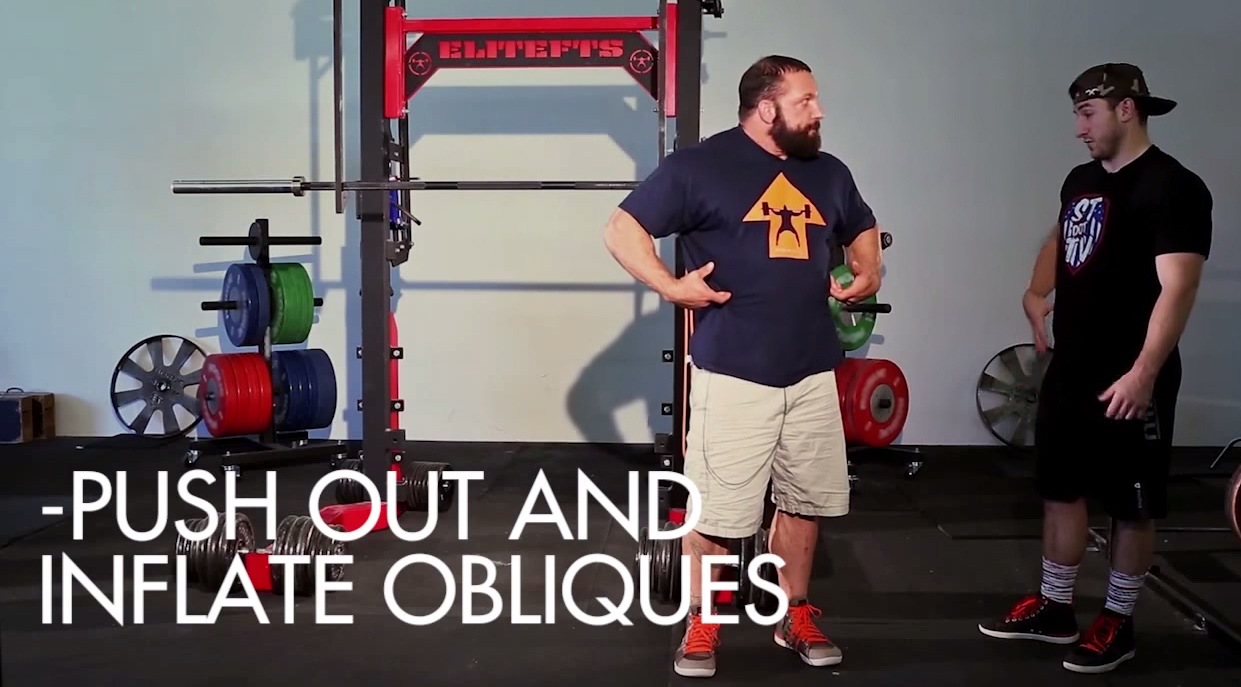
If you’re training squats, you would do some movements that require transferring power through the hip joint with a stabilized core. You would do these with proper IAP as a warm up. You would focus on ensuring that the prime movers such as the glutes are firing properly, and you would practice the cues to engage properly such as ‘rooting’ to the floor, as discussed in many of my videos. The movement selection or cueing of the movement will help with achieving proper joint centration and connecting the muscles with the properly pressurized core. Some examples are goblet squats, rear leg elevated split squats, single leg deadlifts and hip side shifts performed before squatting, as shown in one of my videos.
This movement-based approach teaches the body to turn on properly and lets the central nervous system know that it doesn’t need to down-regulate—as long as you keep proper positioning and IAP while moving to the core, heavy lift. It also gets you warmed up and ready to begin training. It’s an efficient training approach because it takes 5–10 minutes, and when you’re finished, you’re already in the process of being warmed up physically and mentally.
Read the rest of article on EliteFTS.com
The ShouldeRök™ versus a Macebell or Gada

The Macebell or Gada is a classical training tool dating back centuries. Its original use was in the wrestling for fighting cultures of ancient Persia and India. My first experience using one was about 8 years ago when I attempted to incorporate it for shoulder development and conditioning. As a competitive powerlifter I quickly abandoned its use finding that combined with my powerlifting training it aggravated my wrist, elbows, and shoulders.
However 2 years ago I decided to make another run at using the macebell again. I had been making tremendous gains in shoulder health and mobility with my progression into Dynamic Neuromuscular Stabilization (DNS) and some associated kettlebell work. I decided to try the swing again but focus on some refinement in the movement based on the DNS methodologies. The goal was to simply realize some training efficiency as the swing was a very active warmup. If I could accomplish my rehab, prehab, and warmup all at the same time I would have more time to focus on my actual training.
With the new approach to the swing my shoulder pain that I had been experiencing daily for the last 8 years disappeared after the first 30 days. This is pain that had kept me from sleeping, interfered with my training, and I was only able to manage in the short term with mobilizing and re-seating drills. Gone! I couldn’t believe the change. Being surrounded by powerlifters and strongman I found several other test subjects similar to myself and quickly found that the same thing happened. That was when I decided to develop the tool into what we now are marketing to others as the ShouldeRök™. For further details on the value of the ShouldeRök™ and its impact on eliminating issues caused by open chain barbell movements today done with an open scissor you can watch this video of me presenting on the topic to a room full of clinical rehab specialist.
One of key differentiating features is the easy load ability combined with the length of the product. Most products of this type are shorter which allows for the same weight to be used across a broader spectrum. This approach compromises effectiveness effectiveness of their products but is required for those selling ‘fixed bells’. The length of the ShouldeRök™ is designed to maximize balance as well as the eccentric opening and the requirements for muscle engagement and stability. The ShouldeRök™ is simply a superior product for this reason.
A lot of people regard this as a mobility tool and they are really missing the boat as to the true value it provides. Mobility is an output but it is achieved through developing strength and stability with the proper integration of shoulder to core interactions. The strength and stability are achieved with the proper cueing patterns and core stabilization while applying dynamic load as the shoulder moves through its entire range of motion. In addition all the supporting muscles of the shoulder girdle are engaged and develop particularly as you add progressive load. The ShouldeRök™ and ShouldeRök™ method provide strength development, improve stability and shoulder to core integration, and increase mobility. These improvements are made all with the use of a fun and highly efficient warmup or cool down to any workout.
Over the next year and a half after realizing these changes in my shoulder health I continued to refine the DNS inspired cues and approach to the swing. I also put on my engineering hat and decided to improve the product itself. I lengthened the bell and improved the balance with proper material selection giving it a very unique swing characteristic compared to others on the market. We had some shot loadable bells in the gym but it was such a pain to change the weight that it was never done. With micro-loading progression and small weight differences making a big impact between one athlete to the next I felt that changing weights quickly was a critical piece. I chose to have it plate loadable with Olympic plates. This allowed for developing a loading method that would ensure the safety of the lifter and those around them. Having a weight fly off the end of a bell just wasn’t acceptable, or compromising the proper handle size to use 1” plates. For comfort and control I added knurling and flaring of the handle. The handle has 14″ of flaring so that shorter lifters can choke up on the handle and use it as a shorter device.
The ShouldeRök™ was branded as a separate product than just a macebell due to the unique nature of the specific coaching cues that are provided to customers and significant design refinement of the product. It is simply the best product of its type on the market and video series with it was developed by one of the best strength athletes and strength coaches in the world today.
It’s time to get strong! Its time to get your ShouldeRök™ today!
ADDENDUM - Recent Reviews
IMPROVE SHOULDER MOBILITY AND LOOK LIKE CONAN THE BARBARIAN
Craig Marker, Ph.D., CSCS, SFGII, is a fitness enthusiast who has spent his life trying to help people improve their lives. He is a professor at Mercer University teaching psychology and research methods.
GARAGE GYM REVIEWS – SHOULDEROK
I’ve created this site to provide honest reviews as well as instructions for DIY equipment. There is an absolutely absurd amount of equipment available for purchase today, and I will help guide you through what is worth using, and what is not.
Wide Stance Groin Health - Passive Compression | Hip Airplane | Targeted Volume
In December of 2012 I tore my right adductor in a meet. I had actually had some minor tearing early in the year and had been managing it to keep training but with a 782 competition squat it let go on me.
After rehabbing the area I determined a need to reduce my injury risk. With squatting wide and pulling sumo it simply puts a lot of strain on this area that is sometimes slow to recover. It is also a faily common injury point with lifters.
One of the ways I have reduced this risk is with ensuring proper recruitment patterns are firing before this heavy eccentric load. This is done with a specific warmup routine and test-retest methodology before jumping under squats. I reviewed this warmup routine on Breaking Muscle.
That write up only covered that specific warmup and also skipped the hip-airplane that I often employ as part of it.
In this video piece I go into depth on the hip-aiprlane that is used before I squat and pull but also passive compression and some targeted volume work. The passive compression can make an instantaneous improvement if you have some issues in this area and also seems to improve recovery as well as reduce injury risk. I employ passive compression in training on pretty much every heavy set for this reason. A hammy band or a compression band work great. In addition to the passive compression it’s great to work in some volume work to stimulate flushing of this low blood flow area. An example of this is provided in the video as well.
This is not the be all and end all of groin health, but just the methods I have employed with success. It has allowed me to successfully move from that failed squat at the beginning to the standing world record 881 squat 2 years later with no aggravation of this injury.
“The Mad Scientist of Powerlifting”? Stan Efferding w/Chris Duffin
Last weekend I took a trip to Las Vegas and worked with my friend Stan Efferding (Worlds Strongest Bodybuilder) and also Eric Spoto (worlds strongest raw bench presser). I have been working with Eric Spoto on his rotator cuff surgery rehab plan over the last several months. Eric has been working with his physical therapist on his rehab plan while I was guiding him on his training in the gym and other recuperative movements that fell within those parameters. With Eric’s progress he had reached a point that we could begin incorporating the ShouldeRok to deal with some of the root issues that could have led to his surgery to begin with. It was time to build the platform for ongoing strength and shoulder health for his continued dominance in the bench press, prompting this trip.
Upon learning that I was coming down I received a text from Stan asking if I could help him dial in some changes to his deadlift. At least the text was sent to my phone, but I was confused as he was referencing the “mad scientist” for assistance. Upon arriving at the Iron House gym Stan cleared up that he was indeed talking about me, as you will see in the following video. Upon reflection the nickname is fitting given my tendency to tinker with and improve everything including my machining, 4 wheeling rigs, gym devices, and human movement.
Don’t worry the actual coaching videos will follow in coming weeks: “The Mad Scientist of Powerlifting”? Stan Efferding w/Chris Duffin
Dieting & Staying Strong - Week 2
Dieting & Staying Strong wk2 - 2014wk50
Week 2 of my diet. Dropping some pretty decent weight but still feeling strong. My waistline has dropped 1.75” so far but not much change on the calipers yet so its mostly visceral fat loss as this point. Pleased with the results and will keep at it.
MONDAY
ShouldeRok Swings x 3 sets
Curls x 3 sets
Bench
135×5
225×3
315×3
405×2
455×1
495×1
405×8
Dips
Bw+160×12,10,8
Machine shoulder press
Stack x 15,15,15
Overhead tri extension
X12,12
WEDNESDAY
ShouldeRok Swings x 3 sets
Deadlift off 3” Blocks w/50lb band on hips and 40lb band on shoulders
155×5
265×5
375×5
485×3
595×3
685×6…. Nice pull for me with no straps
Pause Squats w/5 sec pause
335×3
425×5,5
THURSDAY
Fasted training for first time in long time.
Dips x70,50,50,50
Leg Extesnion stack x20,20,20,20
KB Front Twist Raise 26×16,14,14
One arm hangs (Sec) 25s, 25s per side
SATURDAY
ShouldeRok Swings x 3 sets
RDL’s off 3” block
265×1
375×1
485×1
595×1,1
I had some excruciating back pain thus doing singles and not doing reps. Finally had to just call the workout a wash and quite.
Seated Machine Rows
Stack x20,20,20,20
Pullups x16,14,8
My wife dropped off the kids with me at the gym but they were entertaining themselves well so I got a massage from our practicing masseuse student who was in that afternoon. Found some serious triggers in my piriformis and got my psoas to release. Back pain alleviated. I would love to get a makeup workout in on Sunday but since I’ll be out of town for work most of next week its not gonna happen.
Make sure to visit my sponsor and fellow teammates at EliteFTS.
Hip Thrusters Revisited - More Is Not Better
Hip Thrusters… They’re a great DNS tool and used for assessments and coaching queue’s moving athletes into bigger and bigger movements. But heavy weighted thrusters? Totally unnecessary!